


State governments are increasingly enacting Extended Producer Responsibility (EPR) laws to encourage a circular economy. Many of these laws shift the financial burden away from the parties with the most control over packaging decisions–such as consumers, retailers, and manufacturers–and place mandates and fines on wholesaler-distributors instead. Distributors primarily serve the business-to-business market, providing warehousing, logistics, and shipping between manufacturers and retailers. They should not be classified as “producers” under EPR laws. NAW supports the goals of circularity but believes EPR laws are unconstitutional and structured in a way that undermine, rather than advance, their intended goal.
NAW Action
July 30, 2025: NAW filed a lawsuit in the U.S. District Court for the District of Oregon, arguing that Oregon’s Plastic Pollution and Recycling Modernization Act is unconstitutional. The law broadly regulates the supply chain and affects interstate commerce while delegating regulatory authority to a private, third-party organization.
February 6, 2026: NAW secured a preliminary injunction blocking Oregon’s DEQ from enforcing the Act against NAW members until the court ruled on the merits. The court found the law’s opaque regulatory scheme raised serious Due Process and Dormant Commerce Clause questions.
June 22, 2026: NAW joined Nebraska Attorney General Mike Hilgers and 16 other state attorneys general in a federal lawsuit challenging California’s SB 54 (Nebraska v. Heller). NAW is the only business plaintiff. The suit challenges SB 54 under the Commerce Clause, First Amendment, and nondelegation doctrine.
July 13-17, 2026: A federal trial took place in Portland, Oregon, where NAW challenged the constitutionality and effectiveness of Oregon’s EPR law.
July 30, 2026: NAW filed NAW v. Ryan, challenging Colorado’s Producer Responsibility Program for Statewide Recycling Act (HB 22-1355), along with a motion for preliminary injunction.
August 20, 2026: NAW and the 17-state coalition filed a motion for preliminary injunction to block enforcement of SB 54 while the case proceeds, along with an amended complaint.
August 27, 2026: Oregon’s district court ruled against NAW in NAW v. Feldon. The ruling is a narrow, fact-bound holding confined to this record and Oregon’s specific statute, not a binding precedent or a categorical ruling on private delegation. NAW issued a statement on August 28, 2026. Further action is pending.
The NAW Legal Policy Center serves as the voice of the wholesale distribution industry in precedent-setting litigation in courts across the country to defend the free enterprise system. Learn more.
Press Coverage
NAW’s legal challenging of EPR laws has drawn coverage from trade publications, legal analysts, and business press. Below is a selection of recent coverage.
- Oregon Recycling Ruling Gives Supporters Hope in California, Colorado | Barron’s (August 31, 2026)
- Supply chain lobby heads to court | Politico (July 13, 2026)
- Oregon’s groundbreaking packaging recycling law goes on trial | Portland Business Journal (July 13, 2026)
- Wholesalers challenge Oregon packaging-reuse law, arguing it ‘isn’t about recycling’ but revenue | The Oregonian | (July 13, 2026)
- Packaging EPR goes on trial | Packaging Dive (July 7, 2026)
- California’s landmark anti-plastics law sparks anger as 17 states move to sue | The Guardian (June 26, 2026)
- Seventeen States and NAW Challenge California’s Packaging EPR Law | National Law Review (June 26, 2026)
- Multiple state attorneys general sue California over single-use plastics law | The Baltimore Sun (June 25, 2026)
- California’s Plastic Law Goes to Court: Is It Too Strict or Too Lax? | New York Times (June 24, 2026)
- 17 states and trade group sue California over plastics packaging law | Associated Press (June 23, 2026)
- Battle over single-use plastics erupts as 17 states move to block California law | Los Angeles Times (June 23, 2026)
- US states sue California over landmark plastics packaging law | Reuters (June 22, 2026)
- The viral hits coming for Newsom’s green agenda | Politico (June 22, 2026)
- GOP-Led States Sue to Stop California Plastic Packaging Law | Bloomberg Law (June 22, 2026)
- NAW Joins 17-State Challenge to California EPR Law | Modern Distribution Management (June 22, 2026)
What EPR Laws Are
EPR is a policy approach that makes producers responsible for their products throughout their lifecycle, including after consumer use. Producer definitions vary by law, but many states define a producer as a company that sells, distributes, or imports the covered material into the state. Supporters say EPR helps achieve environmental goals like recycling targets and more circular product design.
States increasingly require producers to join a Producer Responsibility Organization (PRO), a non-governmental entity that sets fees and standards and manages the program. Producers register, report, and pay fees to the PRO, which uses the funds to cover the program’s costs.
7 States Have Passed Packaging and Paper EPR Laws
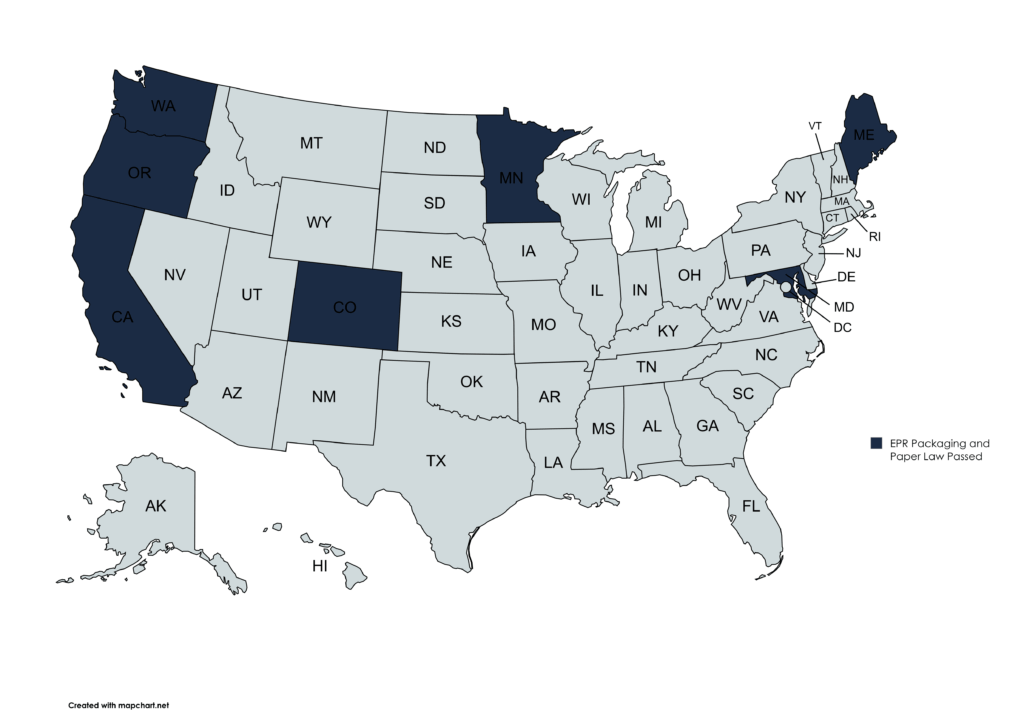
Below is a current list of states that have passed EPR laws focused on regulating packaging, plastic, and paper products. NAW continues to track and monitor EPR legislation in the states, and report on developments in NAW’s Bi-Weekly State Update.
California | Plastic Pollution Prevention and Packaging Producer Responsibility Act:
Governor Newsom signed SB 54 into law in June 2022. CAA is the state’s approved PRO.
- Governor Newsom signed SB 54 into law in June 2022. CAA is the state’s approved PRO.
- October 14, 2025: NAW and other organizations requested CalRecycle and CAA delay SB 54’s initial reporting requirement until permanent regulations were finalized.
- NAW submitted comments on CalRecycle’s proposed regulations in October 2025 and February 2026.
- May 1, 2026: SB 54 regulations took effect, with a 30-day compliance window.
- June 22, 2026: NAW joined a 17-state attorney general coalition challenging SB 54 as the sole business plaintiff.
- August 20, 2026: NAW and the coalition filed a motion for preliminary injunction and an amended complaint.
Colorado | Producer Responsibility Program for Statewide Recycling Act:
Governor Polis signed the bill into law on June 3, 2022. Obligated producers must sign CAA’s Participant Producer Agreement and Colorado State Addendum and report by July 31, 2025. CAA was appointed PRO in May 2023, with producer payments beginning in 2026.
- July 23, 2025: NAW requested a delay of the effective date, citing widespread confusion over registration and covered products.
- October 3, 2025: Colorado’s Hazardous Materials and Waste Management Division denied the extension.
- July 30, 2026: NAW filed NAW v. Ryan, challenging the law, along with a motion for preliminary injunction.
Maine | Stewardship Program for Packaging:
Maine passed a law establishing a packaging stewardship program in July 2021. Governor Mills signed LD 1423 in June 2025, amending product exclusions and definitions. Maine will contract with a Stewardship Organization in 2026; the program becomes fully operational in 2027.
Maryland | Packaging and Paper Products – Producer Responsibility Plans Act:
Governor Moore signed SB 901 on May 13, 2025. Maryland approved CAA as its PRO. Producers must register with the state by July 1, 2026.
Minnesota | The Packaging Waste and Cost Reduction Act:
Governor Walz signed the bill in May 2024. The MPCA accepted CAA’s registration to implement the program. Producers must join a PRO registered with MPCA by July 1, 2025; the program begins in early 2029.
Oregon | Plastic Pollution and Recycling Modernization Act (RMA):
The law took effect January 1, 2022, with producer fees implemented in July 2025. CAA is Oregon’s only approved PRO.
- NAW requested a one-year delay of the July 1, 2025 effective date due to widespread confusion over registration and covered products; Oregon DEQ denied the request on June 23, 2025.
- July 30, 2025: NAW filed a lawsuit in the U.S. District Court for the District of Oregon, arguing the RMA is unconstitutional.
- July 13-17, 2026: A federal trial took place in Portland, Oregon, where NAW challenged the constitutionality and effectiveness of the RMA.
- August 27, 2026: The district court ruled against NAW. The ruling is a narrow, fact-bound holding confined to this record and Oregon’s specific statute, not binding precedent or a categorical ruling on private delegation. NAW issued a statement on August 28, 2026. Further action is pending.
Washington | SB 5284, the Recycling Reform Act:
Governor Ferguson signed the bill on May 17, 2025. A PRO must be selected by January 1, 2026, with producer registration due by July 1, 2026. Washington’s Department of Ecology named CAA to lead implementation.
To learn more about EPR, contact the Government Relations team:
[email protected] or call 202-872-0885