

Big Picture
Colorado completed its primary elections on Tuesday, June 30. The contests unfolded against a dynamic backdrop, with the state’s increasingly blue and unaffiliated electorate reacting to a second Trump term. More locally, a wide swathe of Colorado’s Democratic electorate are also railing against Gov. Jared Polis’ (D) decision to pardon former Mesa County Clerk Tina Peters.
Overall, Democratic progressives were able to channel what appeared to be growing angst against perceived “establishment” candidates for a series of notable wins. Sitting Attorney General Phil Weiser defeated senior U.S. Senator Michael Bennet to run in the November election. As well, political newcomer and self-described Democratic Socialist Melat Kiros surpassed 29-year incumbent Diana DeGette in the 1st Congressional District.
Also, with Colorado opening its primaries to unaffiliated voters several years ago—the largest voting bloc in the state—they again heavily influenced a number of key contests. Unaffiliated registrations now represent 50.5% of active registrations, and candidates for statewide office in particular expressed the need to appeal to those voters. That segment of the electorate will also be a deciding factor in the Colorado general election, which is only four months away.
We will provide additional analysis on governors and attorneys general races in upcoming newsletters, and continue to report on legislation and regulatory changes across the country that impacts our industry. For more information on the bills listed in this update, please visit NAW’s state legislative tracker. If you have any questions or suggestions on NAW’s State Policy Update, please email [email protected].
Labor
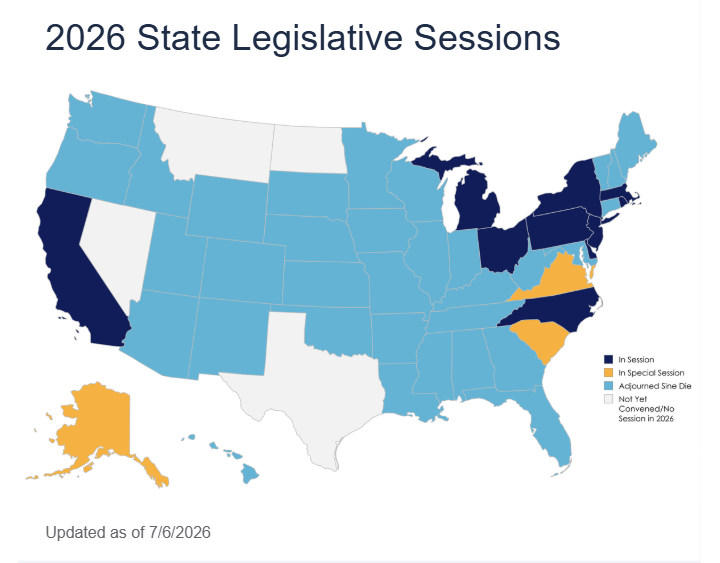
Legislation pertaining to labor issues continue to gain traction in state capitols, particularly those with Democratic majorities. The legislation outlined below spans a host of issues that may affect wholesaler-distributors as employers in Rhode Island, California, and New Jersey.
- Rhode Island wrapped up its legislative session on June 30, with Gov. Dan McKee (D) signing the following workforce-related bill in the last few weeks: H 7364/S 2504 requires large warehouse employers (those with 100+ employees at one warehouse or 1,000+ across multiple warehouses) to give workers written notice of productivity quotas, prohibits quotas that interfere with breaks or safety, and protects employees from retaliation for exercising their rights. The law takes effect Jan. 1, 2027.
- In California, AB-177 was introduced in response to the recent federal Medicaid cuts and corporate tax changes. The bill has passed the Assembly and is pending consideration in the Senate. It would require the Department of Finance to develop policy options to hold large employers financially responsible for the costs of their employees’ Medi-Cal enrollment. The department must submit a report to the Legislature by March 1, 2027.
- California lawmakers also passed AB-2545 out of the Assembly, which would establish a project within the state’s Employment Development Department to assess the impact of advanced artificial intelligence on California’s workforce. It creates a 14-member advisory panel to guide the review, identify data gaps and evaluate effects on workers, including displacement and impacts across demographic groups. The panel is required to submit findings and policy recommendations to the legislature by Jan. 1, 2028.
- In New Jersey, legislators introduced a bill (A5316/S4458) which would establish a five-year program to address the workforce impacts of artificial intelligence (AI). The bill would require large employers to provide advance notice of AI-related layoffs and create targeted support for displaced workers, including extended unemployment benefits, wage insurance and training opportunities.
Tax
State-level tax bills continue to be considered and signed into law across the country. Below are legislative proposals in Rhode Island, California, and New Jersey that may impact the corporate tax environment for wholesaler-distributors with operations in these states.
- In Rhode Island, H 7477/S 2780 repeals the state’s existing LLC statute and replaces it with a new Uniform Limited Liability Company Act. The bill updates rules governing LLC formation, management and member rights, and shifts authority determinations to general agency law. The bill also establishes procedures for mergers, conversions and domestications, updates administrative filing requirements, and maintains provisions for professional LLCs and low-profit entities. The new law takes effect Jan. 1, 2028, and will apply to all LLCs beginning Jan. 1, 2029.
- Rhode Island Gov. McKee also signed H 8324/S 3212 into law, which will amend state laws on secured transactions, business filings and corporate entity formation to address business identity theft, unauthorized filings and deceptive solicitations. It also authorizes the secretary of state to terminate fraudulent financing statements, establishes requirements for third-party business solicitations and creates procedures to report unauthorized entity formations. The law is now in effect.
- California’s SB-176 is a revenue trailer bill for the 2026-27 budget that has passed the Assembly and is advancing through the Senate. The bill includes statutory changes necessary to implement the Budget Act of 2026, including establishing a permanent business tax credit limitation beginning with the 2027 tax year. The cap is set at $5 million per company per year or 50% of a company’s tax liability, whichever is greater.
- In New Jersey, A5227 would impose a temporary five-year, 90% surtax on certain tariff refunds received by business taxpayers. The surtax applies to refunds issued by U.S. Customs and Border Protection under specific presidential tariff actions. Revenue from the surtax will fund grants for small businesses affected by tariff-related price increases, rebates for low- and moderate-income households, and enforcement of consumer protection.
Pricing
Legislation that regulates the ability of businesses to set prices remains an emerging trend for several state legislatures. For example, legislation in Michigan and Pennsylvania may affect wholesaler-distributors’ processes and practices for determining prices for goods and services sold in these states.
- Michigan lawmakers introduced HB 6102, which would prohibit excessive pricing for certain commodities, including building materials, consumer food items, goods, services, and emergency services and supplies, during a declared state of emergency. The bill defines an ‘excessively increased price’ as a price more than 20% higher than pre-emergency levels, unless the seller can justify the increase due to higher costs. This bill is tie-barred, meaning it can only be enacted alongside related legislation, including HB 6103 and HB 6104.
- HB 6098 would amend the Michigan Consumer Protection Act to prohibit the use of “surveillance pricing” in the sale of goods and services. The bill adds this practice to the list of unfair, unconscionable or deceptive acts under state law. It defines surveillance pricing as adjusting prices based on an individual’s personal data, such as device type, location, browsing history or purchasing habits. The bill is tie-barred with HB 6099.
- Lawmakers in Pennsylvania put forward HB 2626, which would amend Pennsylvania’s Unfair Trade Practices and Consumer Protection Law to make it an unfair or deceptive practice for retailers in physical stores to use “dynamic pricing” (prices that change in near real-time and are updated electronically/remotely) if those prices are displayed electronically in the store.
Trucking
New trucking-related legislation continues to be signed by governors across the country. The bill highlighted below in Rhode Island, for example, will address issues related to size, weight, and load limits of vehicles.
- Rhode Island Gov. Dan McKee (D) also signed legislation addressing commercial vehicles and state transportation regulations. H 7869A/S 3002 updates regulations governing the size, weight and load limits for motor vehicles, including commercial, agricultural, emergency and specialized vehicles. The bill clarifies and expands exemptions for certain vehicle types, increases the maximum length for single vehicles from 40 to 45 feet and adjusts fines for violations. It also revises the permitting process for oversized vehicles, establishes new permit fees, and sets travel restrictions and penalties for noncompliance. The bill and its companion took effect immediately upon passage.
Other News NAW is Reading:
- California Becomes First State to Condition Recyclability Claims on Achieving Recyclability Criteria
- California Appellate Court Clarifies Standard for Knowledge of Employee’s Disability
- Illinois Poised to Make Significant Changes to the PFAS Regulatory Landscape