The wholesale distribution industry is at a digital turning point. Historically, distributors have relied on field sales and physical catalogs to drive revenue, but the landscape is changing. Buyers demand seamless digital experiences, manufacturers are increasingly exploring direct-to-consumer (D2C) channels, and data transparency has become a competitive requirement.
To thrive in this connected era, distributors must evolve into strategic marketers—using data, artificial intelligence, and digital channels to manage the entire customer journey, build brand equity, and deliver value-added services.
In this guide, we will explore why wholesale distributors must rethink their approach, how sales and marketing roles are changing, and the exact strategies you need to build a modern distributor marketing engine:
- How Distributor Sales and Marketing Roles Are Evolving
- 3 Key Distributor Marketing Requirements of the Digital Age
- Top Distributor Marketing Strategies and Channels
- Distributor Marketing FAQs

How Distributor Sales and Marketing Roles Are Evolving
Here’s what a digital-first sales and marketing landscape might look like for businesses and customers:
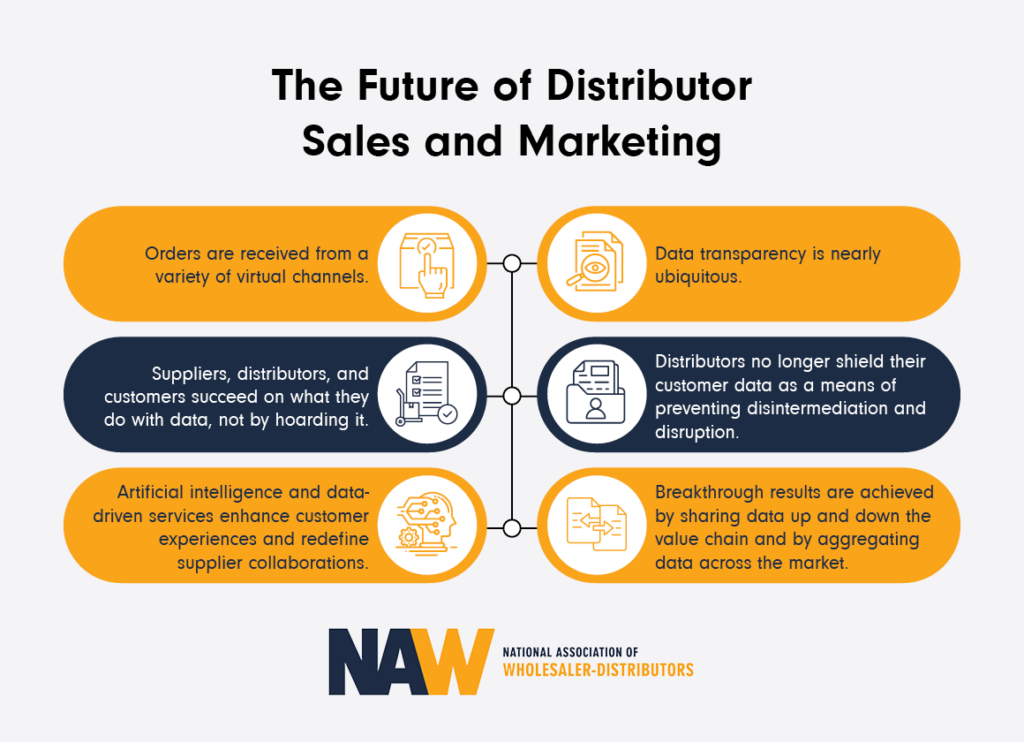
- Orders are received from a variety of virtual channels, including a distributor’s online store and mobile apps, as well as customer e-procurement platforms and online marketplaces.
- Data transparency is nearly ubiquitous.
- Suppliers, distributors, and customers succeed on what they do with data, not by hoarding it.
- Distributors no longer shield their customer data as a means of preventing disintermediation and disruption.
- Artificial intelligence and data-driven services enhance customer experiences and redefine supplier collaborations.
- Breakthrough results are achieved by sharing data up and down the value chain and by aggregating data across the market.
As this future unfolds, customer-facing positions will focus on activities that create value for customers through methods that simultaneously strengthen a distributor’s brand and relationships. Marketing programs intended to spur orders as a direct response disappear.
Instead, distributor marketing teams will:
- Manage virtual and real-world customer communications. Now, the goal is to showcase the distributor’s capabilities, differentiate from the competition, and listen to customer needs and feedback. Salespeople are judged by their ability to identify customer opportunities and solve problems in a manner consistent and integrated with marketing communications.
- Identify service opportunities to match customer performance requirements. This process resembles how manufacturer marketing organizations identify opportunities and define required product features and benefits. Sales management shifts toward a marketing focus, as managers coach salespeople to deliver carefully crafted customer experiences. All of this is accomplished under a strategic vision for a distributor’s brand and requires state-of-the-art expertise around business relationships, loyalty, and brand equity.
Today, many distributors want to improve their tactical marketing capacities around product content, social media, digital campaigns, and more. These skills are essential, and distributors are playing catch-up—but more development is needed. Distributors need strategic marketing capabilities to launch brands, manage customer journeys, redefine supplier partnerships, and drive meaningful, measurable financial and operational results.
3 Key Distributor Marketing Requirements of the Digital Age
In addition to the evolution of sales and marketing roles, there are at least three requirements for the digital age that point to the need for distributors to develop strategic marketing capabilities:
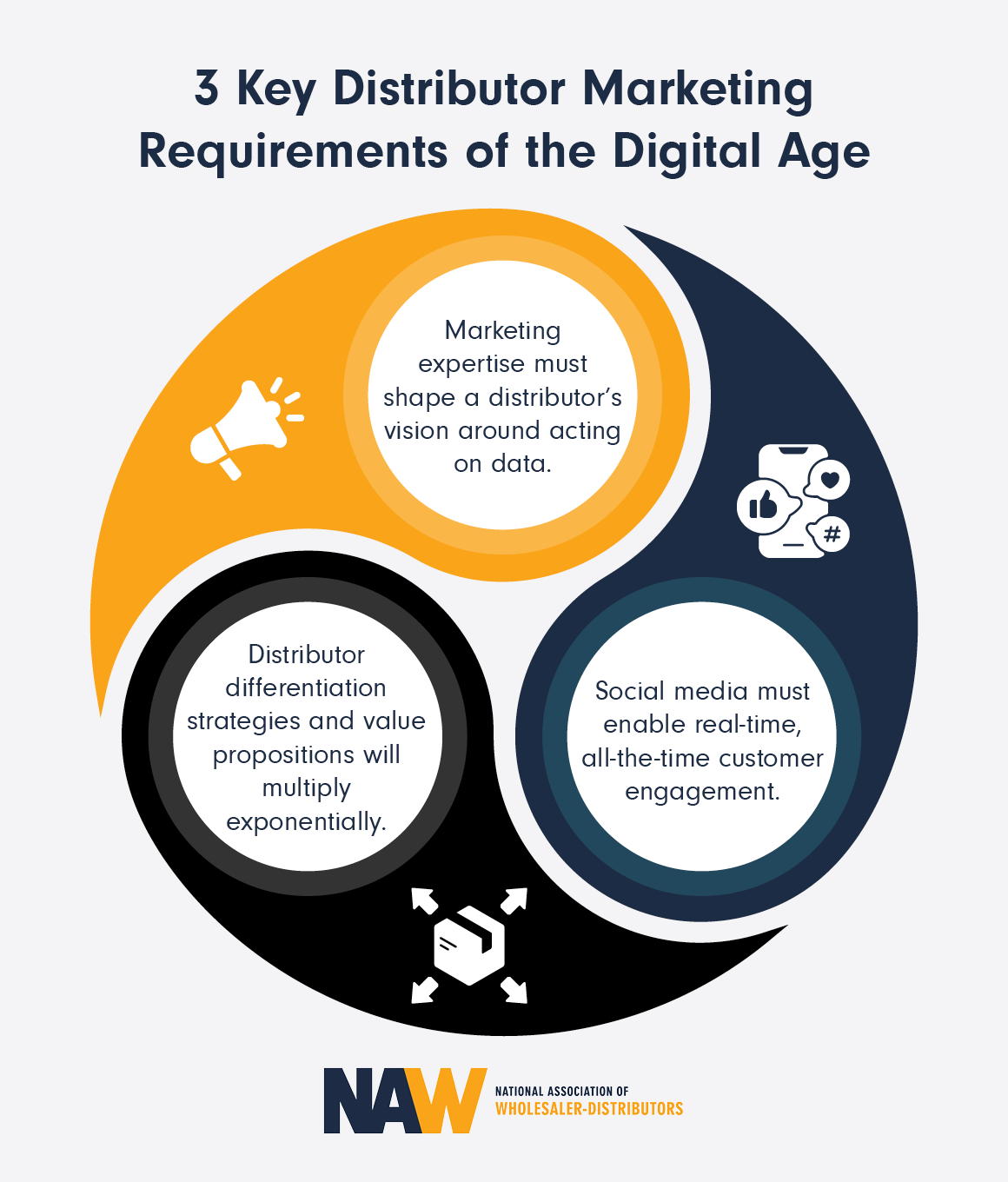
1. Marketing expertise must shape a distributor’s vision around acting on data.
Analytics, artificial intelligence, and machine learning will drive operational efficiencies for distributors. However, in connected markets, distributors achieve differentiation by leveraging data for the customer’s benefit.
Distribution marketing expertise is essential for understanding how customers make decisions in the digital age and their willingness to pay for data-enabled services. Data-enabled services power brands and relationships by enabling distributors to offer tailored recommendations that increase customer value and encourage repeat business. This is a state-of-the-art marketing concept applied in a distribution-centric business model.
2. Social media must enable real-time, all-the-time customer engagement.
Years ago, NAW helped a distributor design and facilitate a customer innovation workshop to identify customer issues and develop solutions. Customers were invited to present on their opportunities and challenges and to explain how their markets work. Key suppliers were asked to look for collaborative solutions that delivered more value than those distributors could provide on their own. The distributor-staffed roundtable discussions included participants from all functions and roles, from leadership to individual contributors. The workshop was conducted as a two-day event and repeated three times a year. It generated real, consequential results.
As distributors evolve to survive and thrive in the digital age, most replicate the process and outcomes of a customer innovation workshop through strategic social media campaigns. Telling customer stories through a distributor’s social media helps distributors learn about customer issues and solutions, and build relationships. Assigning the right hashtags and planning content builds trackable digital reach and presence, reinforcing a distributor’s reputation and brand. Social listening closes the loop by collecting actionable insights.
3. Distributor differentiation strategies and value propositions will multiply exponentially.
Based on our research of the distribution industry, one critical finding is clear: distributors will not succeed in the digital age by moving in lockstep with other distributors. In other words, distributors will not achieve success by being the same. Instead, their success will come from being different.
There are countless ways to combine technology, commerce, and human expertise. The most successful distributor marketing teams will be those that can identify the services and experiences buyers crave and pair them with a compelling brand story.

Top Distributor Marketing Strategies and Channels
To get you started on your distributor marketing journey, explore these recommended strategies and channels.
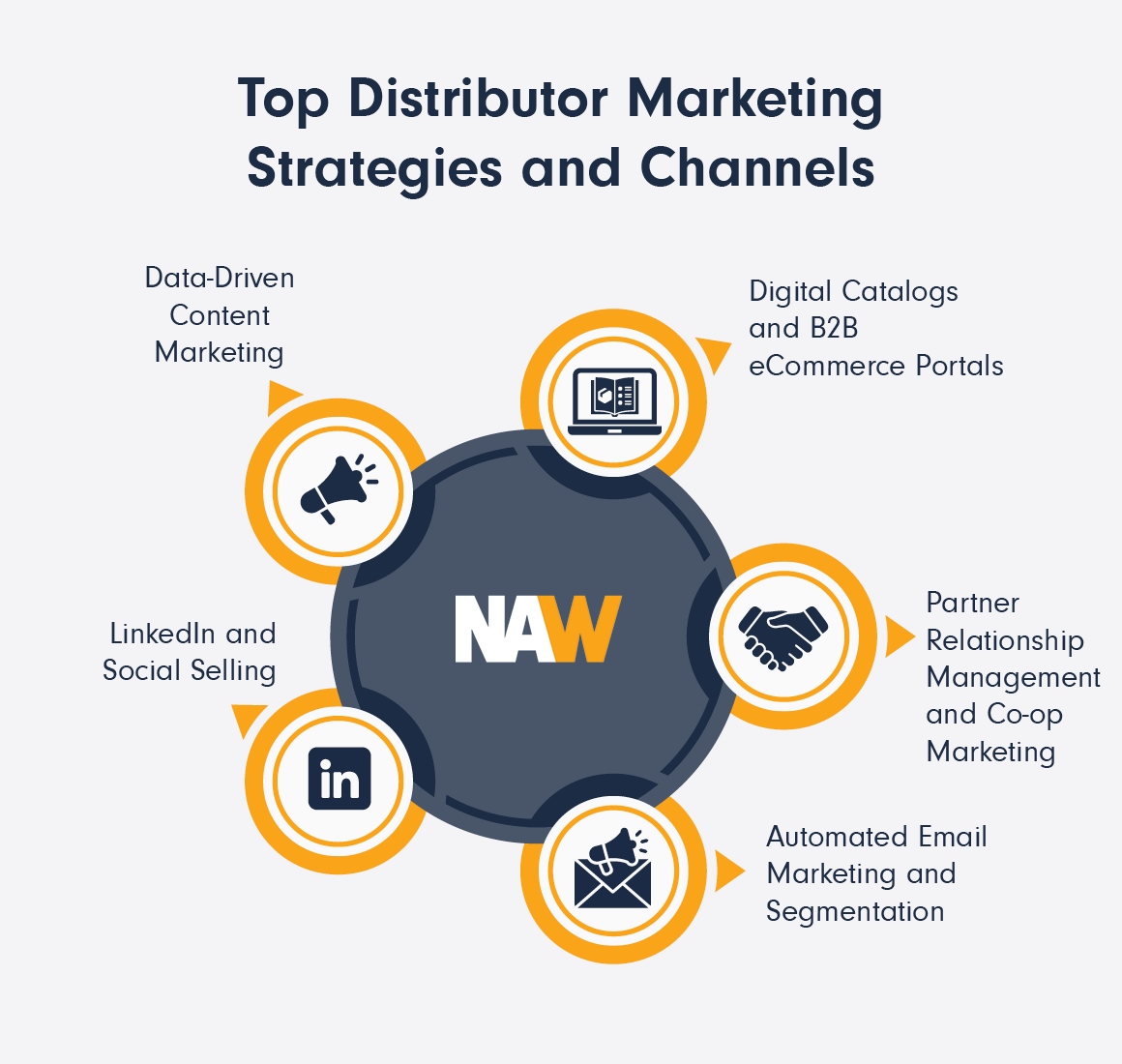
Digital Catalogs and B2B eCommerce Portals
Your website is likely your top sales channel. To keep your website effective, migrate away from static PDF or printed catalogs to dynamic, searchable online ordering platforms.
Make online ordering convenient and accessible by providing:
- High-quality product images
- Rich technical descriptions
- Real-time inventory levels
- Automated reordering workflows
Partner Relationship Management and Co-op Marketing
If your manufacturers have provided you with any marketing resources, don’t forget to use them. Leverage your partner relationship management software and manufacturer portals to access any marketing toolkits. Also, consider using any market development funds (MDF) they provide to create co-branded email templates, localized digital ads, or even run joint webinars.
Automated Email Marketing and Segmentation
Personalize your marketing efforts based on purchasing behavior by integrating your CRM with an email marketing automation platform. Through this type of integration, you can segment buyers based on factors like:
- Industry
- Purchase frequency
- Product category
Then, you can use these systems to automatically trigger emails for abandoned shopping carts, send replenishment reminders for consumable goods, and cross-sell complementary products based on order history.
LinkedIn and Social Selling
B2B distributor marketing thrives on professional networks where procurement managers and executives spend their time. Equip your sales and marketing teams to share relevant content on LinkedIn, such as:
- Thought leadership
- Technical guides
- Industry trends
- Business updates and news
Engage with prospects directly by commenting on their posts, sharing relevant case studies, and positioning yourself as a trusted industry consultant.
Data-Driven Content Marketing
Distributors are uniquely positioned to be the ultimate educational resource for their buyers because they understand how products from multiple manufacturers interact in the real world. Consider developing and sharing data-driven content, such as:
- Technical whitepapers
- ROI calculators
- Comparative product guides
- Video case studies
These types of content will not only help you prove your expertise to potential buyers, but they’ll also fuel your search engine optimization (SEO) efforts, expanding your reach to interested customers searching for terms relevant to your offerings.
Distributor Marketing FAQs
What is distributor marketing?
Distributor marketing refers to the specific strategies and tactics distributors use to promote products, build brand awareness, and drive sales. Since distributors act as middlemen between producers and sellers, their marketing focuses heavily on the service value they can provide to end users.
How does the role of sales change in modern distribution marketing?
In the digital era, distributors must integrate marketing and sales. Sales team members now work like consultants, partnering with marketing teams to deliver thoughtful customer experiences, identify new opportunities, and solve supply chain problems using data.
How should wholesale distributors use social media?
Instead of just posting product updates, successful distributor marketers will use social media for real-time customer engagement and social listening. When leveraged strategically, social media can help distributors share customer success stories, learn about market challenges, and build their reputations as industry thought leaders.
Why is data transparency critical for distributor marketing?
Distributor marketing relies on data to understand how customers make decisions and to develop services tailored to their needs. While distributors used to shield customer data to prevent disintermediation, they now integrate it into their daily operations.
How can a wholesale distributor differentiate its brand from competitors?
Distributors can differentiate their brands by putting the customer first, developing strategies that align with customer needs and expectations. When customers feel seen and heard by their distributor, they’re more likely to continue working with them.
Getting to the Future
Defining strategic distributor marketing capabilities requires effort from across your team. In part, you can start by exploring and applying the best principles and practices of other industries.
However, leaders should shoot for what is ahead, not replicate what worked in the past, even if it is a new practice for distributors. Strategic marketing is about real-world, social, and digital methods, and distributors can get on the right path by focusing on what is new.
The strategic possibilities of digital marketing and social media are the most consequential places to start. As Mark Hewitt, co-founder of Socially Savvy, explains, “Social media enables organizations to engage their customers with an increased reach and frequency. Delivering thought leadership around service and solutions builds the customer’s brand experience, and effective employee communications help overcome barriers for creating a new business culture.”
I need your help. This post reflects my conversations with several distributor leaders, but I need to push the thinking further with inputs from more distribution leaders, as well as from other experts and thought leaders who can help point the way toward distributor marketing excellence in the digital age. Please share your thinking on this with me at [email protected].