





By: Pierce Smith, Senior Content Marketing Manager at Conexiom
Picture this: customer demand surges, orders flood your inbox, and your dedicated team struggles to keep up with the manual tasks required to process them.
This logistical challenge has plagued customer service and sales teams for years. Manual order processing drains precious time and resources, increases the risk of errors, and leads to costly delays.
However, there’s a solution that alleviates the burden of manual processing and enhances accuracy and speed: order management automation. Adopting automated order processing can help your business grow and dramatically boost customer satisfaction.
In this guide, we’ll explore what order management automation entails, its benefits, and how you can implement it:
- What is order management automation?
- Benefits of Order Management Automation
- Examples of Order Management Automation in Action
- Order Management Automation FAQs

TL;DR:
- Order management automation handles the digital data lifecycle of a transaction, such as extracting emailed POs and syncing ERP systems. This is a prerequisite for physical order fulfillment automation, which includes warehouse robotics and logistics.
- By deploying AI to extract and validate data, distributors minimize manual entry errors, prevent inventory mismatches, and deliver a seamless, consumer-like purchasing experience for B2B buyers.
- Transitioning to touchless transactions expedites processing and gives customer service teams more time to focus on value-added selling and complex account inquiries.
- Streamlining workflows enables organizations to process exponentially higher transaction volumes without increasing administrative headcount, effectively reducing labor costs and freeing up capital.
- Real-world enterprise examples demonstrate that implementing an automated platform like Conexiom can enable touchless transactions at scale, saving millions in manual entry costs and reducing processing times from hours to minutes.
What is order management automation?
Order management automation is the use of technology to streamline and manage a business’s entire customer order lifecycle. Rather than relying on human workers to manually enter data, these systems leverage advanced algorithms and artificial intelligence (AI) to process transactions across multiple channels without human intervention.
How does order management automation work?
To replace repetitive, time-consuming administrative work, a modern automated order management workflow typically follows these steps:
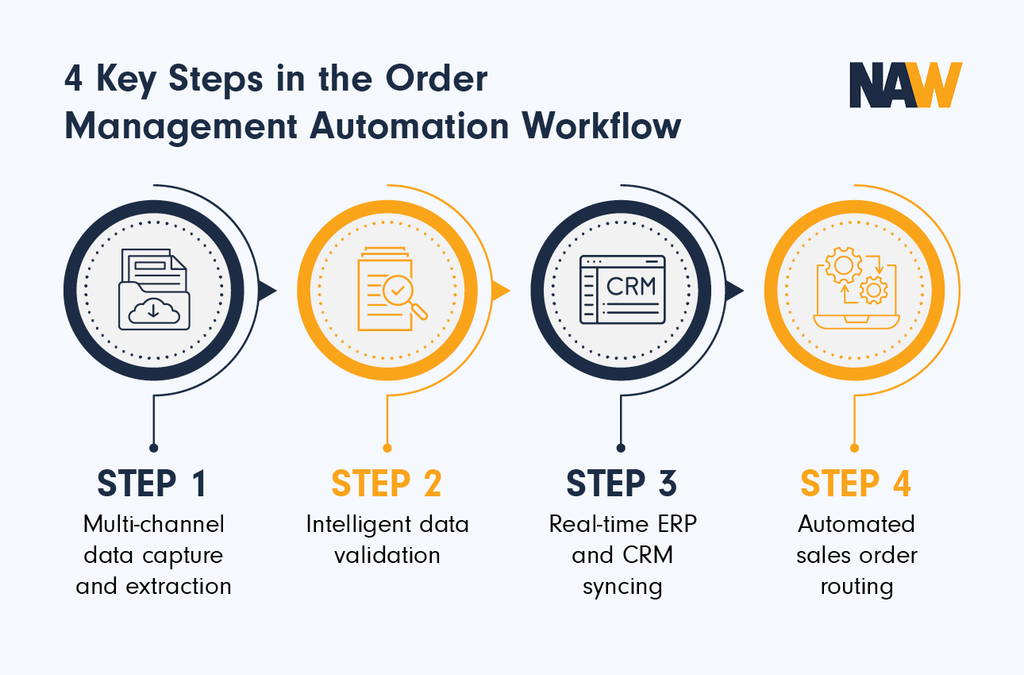
- Multi-channel data capture and extraction. The system ingests orders from every source, including eCommerce platforms, electronic data interchange (EDI), and B2B portals. AI-powered tools can extract unstructured data directly from complex emailed purchase orders (POs) and PDFs and convert it into standardized digital formats.
- Intelligent data validation. Before an order moves forward, the system cross-references the data against existing catalogs and pricing agreements. Self-learning AI automatically flags part number discrepancies or pricing mismatches in requests for quote (RFQs) before they reach the fulfillment floor.
- Real-time ERP and CRM syncing. Once validated, the software immediately sends the clean data into a company’s enterprise resource planning (ERP) or customer relationship management (CRM) system. This creates a single source of truth and instantly updates inventory levels to prevent overselling.
- Automated sales order routing. The validated order is immediately routed to the appropriate warehouse or fulfillment center based on inventory availability and customer location, seamlessly triggering the physical fulfillment process.
Order Management Automation vs. Order Fulfillment Automation
While these terms are often used interchangeably, they refer to two distinct phases of the supply chain lifecycle:
- Order management automation handles a transaction’s digital lifecycle. It includes extracting data from emailed POs, validating pricing, and routing the digital order directly into an ERP or CRM, eliminating manual data entry.
- Order fulfillment automation, on the other hand, manages the physical movement of the product. This process involves warehouse management systems (WMS), automated pick-and-pack routing, robotic sorting systems, and algorithmic shipping label generation.
Understanding the difference between these terms is critical because order management is a prerequisite for order fulfillment. Physical warehouse automation depends entirely on the accuracy of the inbound digital data. For example, if your team enters information manually and accidentally records the wrong SKU or quantity in the ERP, your automated warehouse tools will pick, pack, and ship the wrong item to your customer.
Automating your digital order management workflow guarantees data accuracy from the moment a purchase order is received. With that digital foundation in place, distributors can confidently invest in future-ready warehouses using physical fulfillment solutions like dynamic slotting, wave picking, and automated robotics.

Benefits of Order Management Automation
Manually entering order data increases the risk of errors and slows fulfillment, frustrating B2B buyers. Embracing order management automation empowers distributors to overcome these limitations, with benefits including:
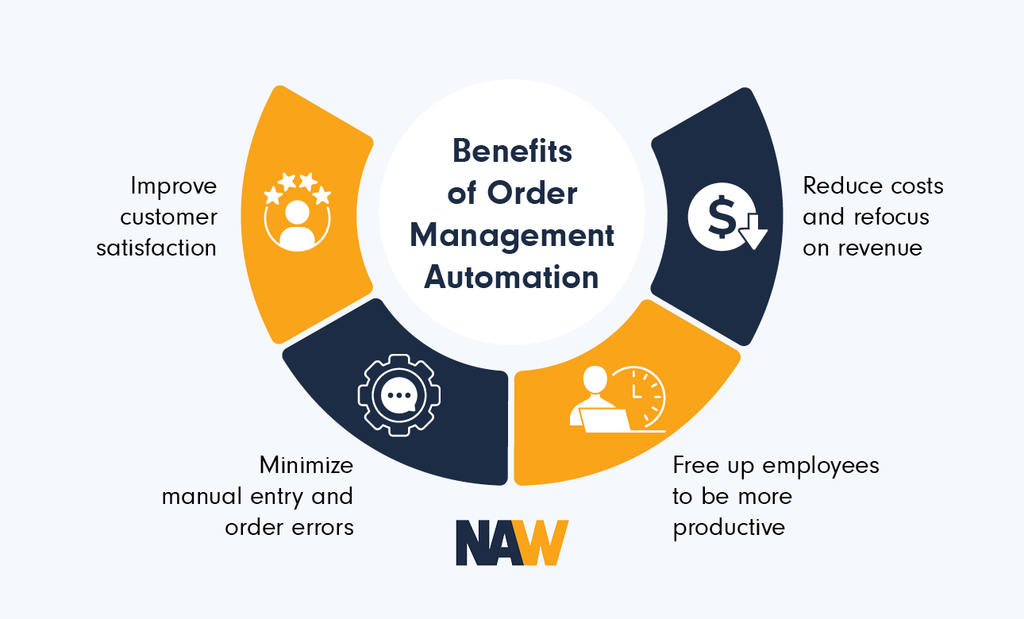
Improve customer satisfaction.
By eliminating the delays and errors associated with manual data entry, businesses provide B2B buyers with a seamless, consumer-like purchasing experience. Automation enables real-time order tracking and instant access to order history across channels.
Automating backend order data is also a critical first step toward enabling B2B self-service portals. A unified data model allows buyers to independently check custom pricing, view accurate inventory, and place orders independently, without waiting for a sales representative. This fundamentally improves the customer experience and fosters long-term loyalty.
Minimize manual entry and order errors.
Manual data entry is a major source of costly operational bottlenecks. Order management automation relies on advanced algorithms to extract and validate data, virtually eliminating keystroke errors, misinterpretations, and omissions.
By deploying agentic AI to cross-reference incoming orders with existing ERP records, the system automatically flags part-number discrepancies and pricing errors before processing. This proactive validation improves data accuracy while preventing the inventory mismatches and accidental overselling that often affect manual operations.
Free up employees to be more productive.
Processing orders manually ties up valuable personnel with rote, repetitive work. Transitioning to touchless transactions speeds up processing and frees customer service representatives from the burden of manual data entry.
With this newfound efficiency, organizations can strategically reallocate their workforce. Automating standard order entry helps customer service teams focus on proactive customer engagement, value-added selling, and resolving complex account inquiries.
Reduce costs and refocus on revenue.
Traditional fulfillment models require companies to add staff as order volume grows. By streamlining workflows and automating routine data tasks, organizations can break this cycle and process significantly more transactions without increasing headcount.
This helps distributors control labor costs, which make up most fulfillment budgets, and free up valuable financial resources. Businesses can then redirect these savings toward innovation, market expansion, and strategic revenue growth.
Examples of Order Management Automation in Action
To understand how these capabilities deliver tangible ROI, it helps to look at real-world B2B distribution scenarios. Here are four examples of how companies have successfully deployed order management automation to transform their operations:
Automating High-Volume Emailed Purchase Orders
For enterprise distributors, the volume of unstructured POs arriving by email can quickly overwhelm customer service teams. A global chemical company with more than $2.5 billion in annual revenue once struggled to manually process its 400,000 annual purchase orders.
After implementing an automated platform, they enabled touchless transactions and cut labor costs by 800%. This shift freed their representatives from manual data entry, so they could focus on revenue-driving activities.
Achieving Accurate Data Extraction
Errors during initial order entry can ripple through the supply chain, leading to incorrect shipments and costly returns. AccuformNMC implemented sales order entry automation to guarantee 100% accurate data extraction from incoming orders.
By eliminating keystroke errors and human misinterpretations, they significantly reduced the cost of h order corrections. Accurate data extraction also enabled them to nimbly handle high order volumes without adding administrative staff.
Accelerating Order Processing Speeds
Slow order processing delays physical fulfillment and puts B2B buyers at risk of switching to faster competitors. Standard Electric used order management automation to completely restructure its workforce allocation and increase order processing speed by 88%. By shifting the repetitive data tasks to software, they drastically shortened their order-to-delivery cycle and improved overall operational agility.
Eliminating Manual Data Entry Costs at Enterprise Scale
Manual data entry is one of distribution’s most expensive hidden costs. By automating routine workflows, a Fortune 100 multinational conglomerate processed exponentially more transactions without adding staff. The automated system reduced processing times from hours to mere minutes, helping the company save a remarkable $3.8 million in manual entry costs alone.
Order Management Automation FAQs
What is the difference between order management automation and fulfillment automation?
Order management automation covers an order’s digital lifecycle, including capturing data from emails, validating pricing, and syncing information with an ERP system. Order fulfillment automation refers to the physical logistics of getting the product out the door, using technologies like warehouse management systems (WMS), automated picking robotics, and shipping label generation.
Can automated software process orders received via email or PDF?
Yes. Modern order management platforms use advanced AI to accurately extract unstructured data from emailed purchase orders, PDFs, and invoices. The software automatically converts this information into standardized digital formats and syncs it directly with your ERP without human intervention.
Will automating order entry replace our customer service representatives?
No. Automating routine data entry removes tedious administrative work and empowers your workforce. With software handling manual tasks, customer service representatives have more time to proactively assist customers, resolve complex account issues, and drive revenue through sales activities.
What software systems need to be integrated for order management automation to work?
To achieve full visibility and a touchless workflow, an automated order management system typically uses APIs to integrate your inbound sales channels, like eCommerce platforms and B2B portals, your customer relationship management (CRM) software, and your enterprise resource planning (ERP) system into a single source of truth.
Implement Order Management Automation with Conexiom
Implementing order management automation is crucial to your business’s success. Industrial B2B’s fast pace means your order processing needs to be faster and more accurate than human effort can typically match.
Even the best-trained employees can still make typos and errors, but with Conexiom’s automation, your order processing can proceed quickly—in under two minutes. Wherever you require manual data entry, Conexiom’s platform can enhance your workforce, improve your customer experience, and support your financial bottom line.
To learn more about how automation can transform your distribution business, explore the following additional resources:
- AI in Distribution: How to Leverage it Effectively in 2026. Explore how distributors use artificial intelligence to optimize inventory forecasting, dynamic pricing, and overall sales execution.
- Unified Commerce and Agentic AI: A New Blueprint for Profitable Growth. Discover how agentic AI monitors signals and makes intelligent operational decisions to scale operations and automate complex workflows like reverse logistics.
- The Path to Operational Excellence: Transforming Warehouses for the Future. Learn about the necessary shift toward cloud-based warehouse management systems (WMS) and the physical warehouse robotics required to complete the automated supply chain lifecycle.

About the Author

Pierce Smith is Senior Content Marketing Manager at Conexiom, where he focuses on creating resources that help manufacturers and distributors make informed decisions about emerging technology and deliver winning customer experiences.