





By: David Bauders, CEO SPARXiQ
Buy low, sell high. It sounds simple, but in many industries today, manufacturer rebates have become increasingly complex and critical to distributor success.
Traditional volume rebates and Special Price Agreements (SPAs, also known as claimbacks) have evolved into increasingly differentiated and targeted incentives that go beyond the usual annual volume brackets to align trading partner interests. They leverage special incentives to accelerate product mix performance, new customer acquisition, share of wallet, cost-to-serve efficiencies, product conversions, and many other valuable performance drivers.
For today’s elite distributors, rebate strategy and execution are critical accelerators of market positioning and competitive strategy. Financially speaking, in many industries, rebates account for at least a quarter of typical distributor profitability. It’s time for savvy executives to up their rebate game.
In this guide, we’ll review the basics of distributor rebates and how you can improve your rebate strategy to ensure profitability:
- What are distributor rebates?
- What causes distributor rebate leakage?
- How to Manage SPAs and Claimback Rebates
- The Total Rebate Opportunity
- Distributor Rebates FAQs

What are distributor rebates?
A distributor rebate is a retroactive financial incentive paid by a manufacturer or supplier to a wholesale distributor after meeting specific purchasing or sales performance thresholds.
Unlike a standard volume discount, which immediately lowers the invoiced cost of goods at the point of sale, a rebate leaves the upfront invoice price intact. Instead, the incentive is accrued and settled later as a credit or cash payout once the qualifying activity is measured over a defined timeframe, such as quarterly or annually.
For modern distributors, this retroactive structure allows manufacturers to protect their baseline market pricing while heavily encouraging distributors to drive strategic behaviors, such as capturing net-new business, defending market share, or optimizing cost-to-serve efficiencies.
Common Types of Distributor Rebates
To align trading-partner interests, traditional volume brackets have evolved into increasingly targeted incentive structures. The most common programmatic rebates include:
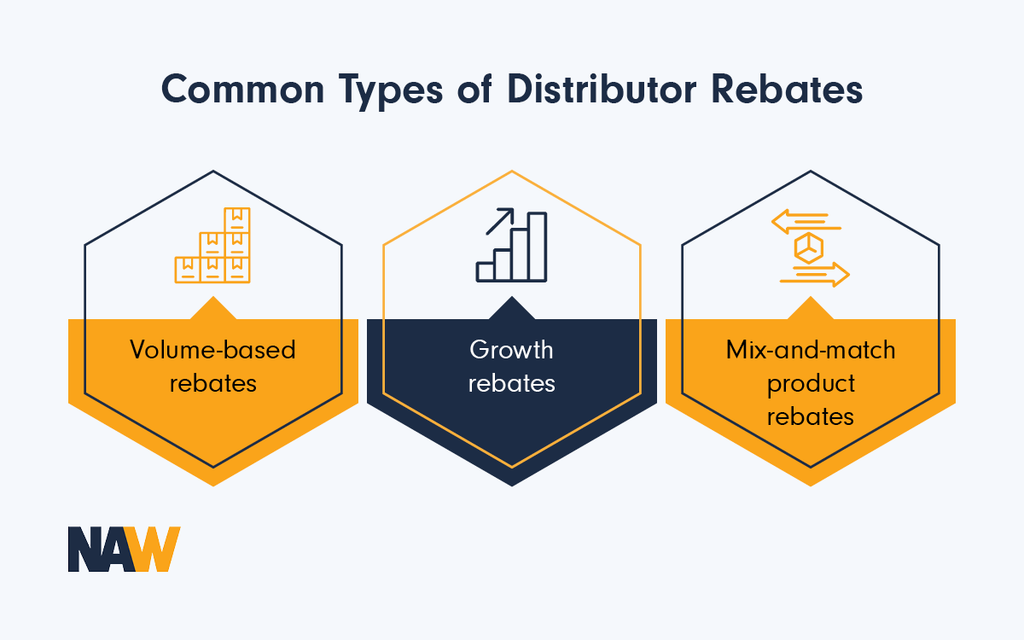
- Volume-based rebates. Volume-based is the most traditional rebate format. Distributors earn a retroactive payout or credit after purchasing a specified quantity or dollar amount of product from a manufacturer within a set period. These are often tiered, meaning the payout percentage increases as higher volume thresholds are reached.
- Growth rebates. Growth rebates incentivize expansion rather than the status quo. These programs pay out based on year-over-year (YoY) or quarter-over-quarter (QoQ) percentage increases in purchasing volume, encouraging distributors to actively shift market share away from competing suppliers.
- Mix-and-match product rebates. These are strategic incentives used to promote a specific basket of goods. Manufacturers reward distributors for selling a specific combination of items, such as bundling a high-margin consumable or accessory alongside a core piece of equipment, to accelerate product mix performance and new product adoption.
What causes distributor rebate leakage?
Most distributors suffer from rebate leakage because they take a reactive approach to their trading programs. Rather than treating rebates as a strategic financial pillar, they treat them as a back-office chore delegated to admin employees. Specifically, this leakage stems from three distinct operational failures:
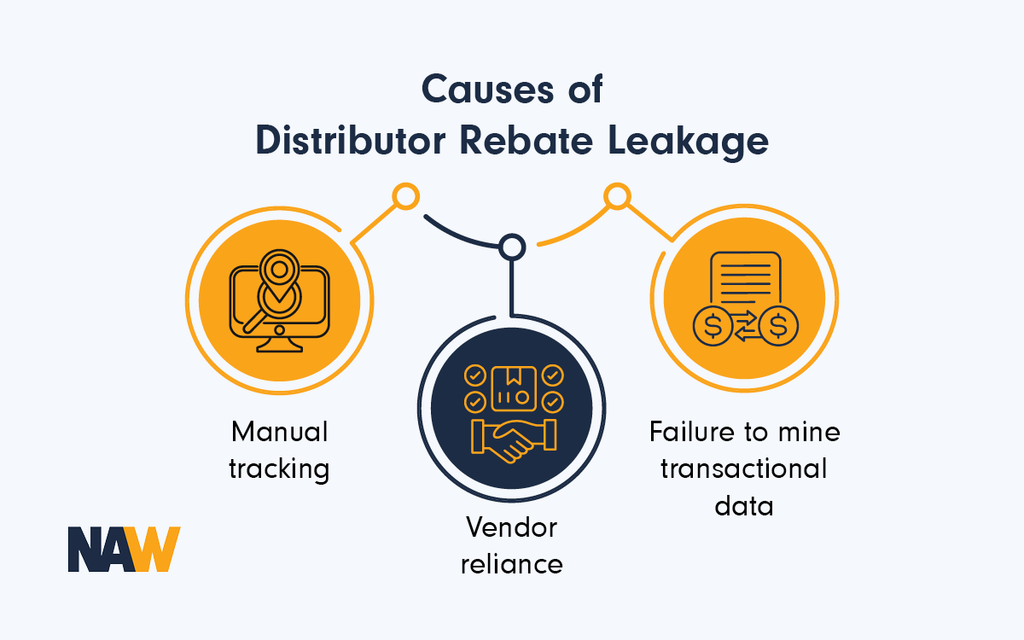
Manual tracking
The primary cause of missing rebate dollars is spreadsheet dependency. Currently, 28% of distributors still rely on Excel spreadsheets to track rebate performance. When relying on static, manual data entry, human error and expired claim windows cause enterprises to leave a portion of the rebate value unclaimed.
Vendor reliance
Because distributors often lack clear data and purpose-built reporting tools, they rely almost entirely on their manufacturer partners to initiate programs, track tiers, and calculate payouts. This lack of internal visibility creates a massive disconnect. Today, 52% of distributors do not believe they actually receive all the rebates they earn. By waiting on vendors rather than proactively tracking their own performance, distributors surrender control over their own profit margins.
Failure to mine transactional data
Many distributors fail to use their own transaction data to guide front-line sales behavior. Without clear data insights, sales representatives miss key market opportunities to grow share of wallet, improve product mix, or reduce cost-to-serve in ways that would trigger lucrative, upper-tier rebate payouts.
The financial cost of this reactive, manual approach is staggering. SPARXiQ data shows a performance gap of 25% or more between elite, proactive distributors and average performers. That represents $250,000 or more of improvement opportunity for every $1 million of baseline rebate capture.
To stop this leakage, distributors must elevate rebates to strategic importance in the business. Proactive distributors are mining their own transactional data to identify new partner opportunities and suggest improvements to existing trading programs. By aligning their internal resources, analytics, and systems to master this complexity, they get access to a new source of investment capital, accelerating profitability and enterprise value.

How to Manage SPAs and Claimback Rebates
In industries with significant variation in price sensitivity, such as large OEM installations versus fragmented daily MRO or repair spend, SPAs have become critical. In key verticals like electrical, HVACR, fluid power, automation, and power transmission, manufacturers rely heavily on SPAs to balance price-sensitive and price-insensitive market segments.
The mechanics are straightforward: the distributor pays standard into-stock pricing for daily orders, and later receives claimback credits for selling into price-sensitive market opportunities. Because SPAs can often yield 30%-50%—or even 70%—off standard stock costs, mastering their execution is a huge opportunity for mutual growth.
However, SPAs introduce operational complexity. A typical distributor with 1,000 vendor product families and 10,000 customers can easily generate tens of thousands of unique, overlapping, and sometimes conflicting SPA permutations. Because front-line distribution sellers are usually tasked with identifying and requesting these SPAs, a “Wild-West” culture of inconsistencies often creeps in, compounded by equally chaotic approval processes from manufacturer sales teams.
To tame this complexity and manage SPAs effectively, distributors must move from a reactive, ad-hoc approach to a highly disciplined strategy by:
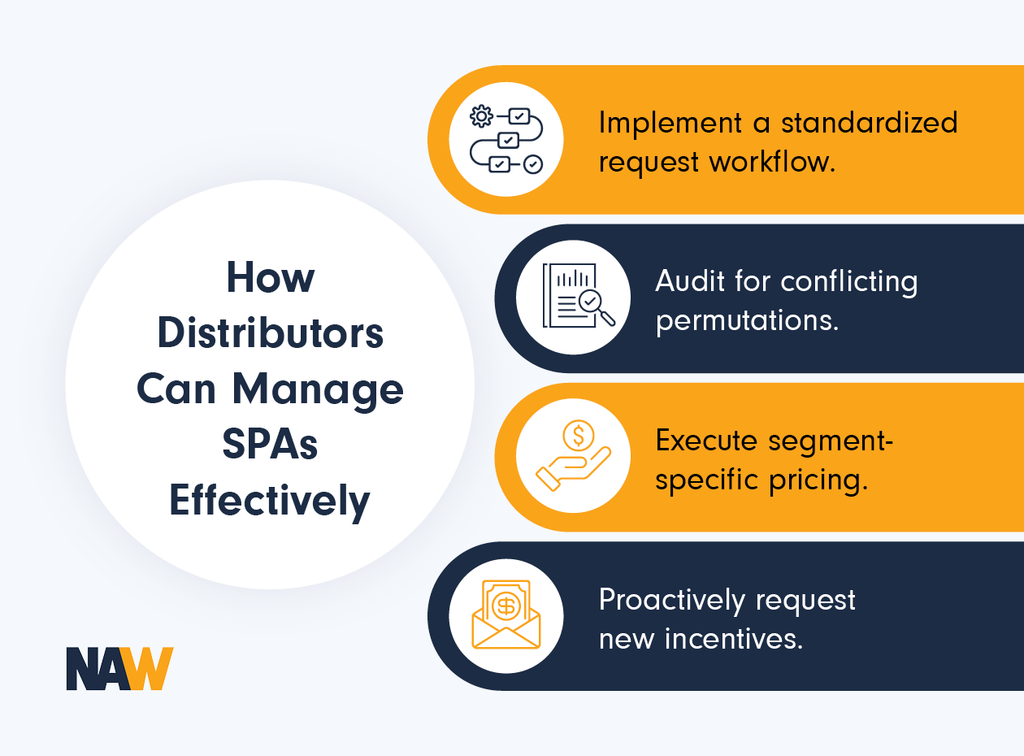
- Implementing a standardized request workflow. A centralized approach creates a formalized, closed-loop process for identifying, requesting, and implementing SPAs with vendor partners, ensuring consistency and speed.
- Auditing for conflicting permutations. With tens of thousands of potential SPA rules across product families and customer segments, distributors must actively audit their agreements to identify redundant or suboptimal terms that lead to claim rejections.
- Executing segment-specific pricing. Tactically apply SPAs to quote aggressively and capture market share in price-sensitive segments (like large projects), while reserving standard stock costs to protect and capture margin in relatively price-insensitive daily spend.
- Proactively requesting new incentives. Do not wait for vendors to offer standard terms. Innovative distributors are actively using their market data to request and negotiate bespoke SPAs in industries where such agreements have not traditionally been common, creating new avenues for mutual growth.
The Total Rebate Opportunity
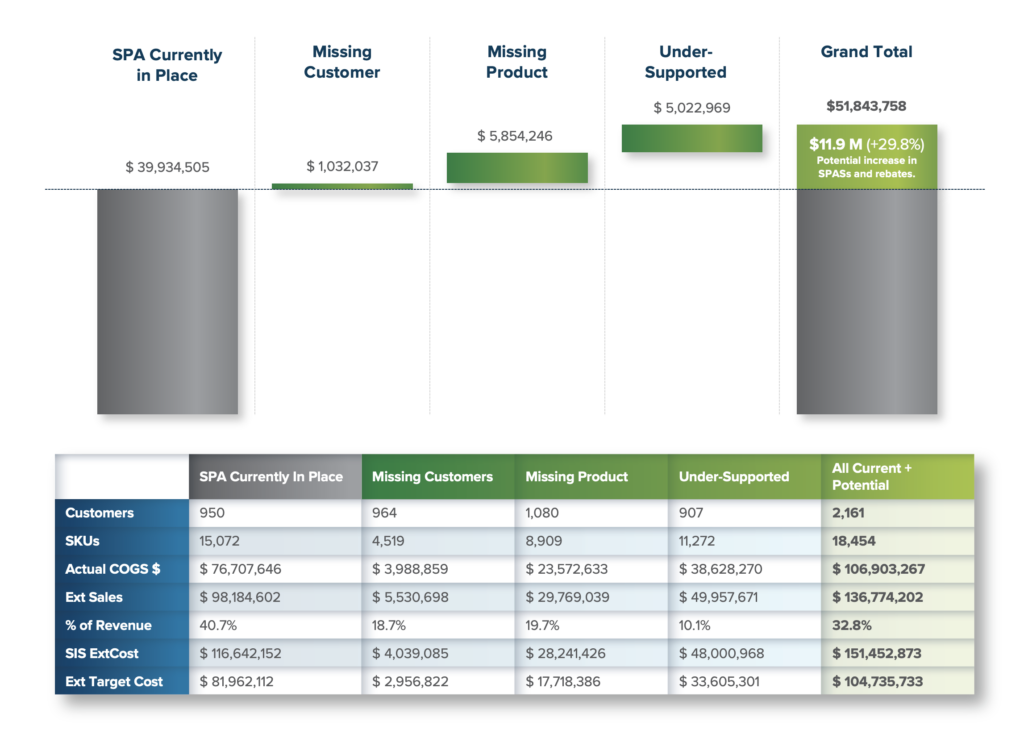
Both programmatic/volume rebates and SPAs consistently fall into patterns of underperformance. Generally, these categories of rebate leakage total 30% or more of a distributor’s baseline rebate capture:
- Missing customers or prospects. Current or potential customers often miss out on eligible rebates despite being identical to peers who already receive them. For instance, a sales representative might fail to apply an available SPA to a new mid-sized contractor, completely unaware that the exact same SPA is already being used for a similar contractor across town.
- Missing products. Products within a customer’s market basket often share spend characteristics with items that already receive rebates. A classic example is allowing a customer to continue buying standard products from one brand when proactively switching them to an equivalent item from another brand would trigger a lucrative mix-and-match rebate tier.
- Under-supported existing rebates. Customer-product combinations are frequently assigned rebate levels far below what elite-performing peer combinations receive, leaving margin on the table.
- Missing vendors. Many vendors lack the reach or strategic insight to understand how their competitors incentivize profitable growth, leading to missed partnership and program opportunities.
- Conflicting or redundant rebates. Complex agreements often result in individual customers belonging to multiple, conflicting, or sub-optimal rebate structures. This frequently results in a single order triggering both a standard volume discount and a specialized SPA claimback, leading the manufacturer to reject the duplicate claim.
To capitalize on the total rebate opportunity, distributors need to master two key dimensions:
- They must apply data analytics and machine learning to their transactional data to identify missing or suboptimal trading programs.
- They need dedicated rebate management software (RMS) to manage the workflow of requesting, negotiating, formalizing, and executing these programs. Without an automated, closed-loop system, there is massive leakage between identifying an opportunity and actually capturing the cash.
This technology must bridge the gap between the back office and the sales floor. By integrating back-end rebate tracking into front-end quoting engines, distributors can equip their sales teams with real-time visibility into pocket margin—the true net profitability of a deal after accounting for retroactive rebates. This empowers representatives to price aggressively, win competitive deals, and accelerate enterprise value.
Distributor Rebates FAQs
What is the difference between a distributor rebate and a standard volume discount?
A volume discount lowers the invoiced price at the point of sale. In contrast, a distributor rebate leaves the invoice at the agreed price and settles a credit after qualifying purchasing or sales activity is measured over a defined window. This retroactive structure allows manufacturers to incentivize specific behaviors, like product-mix improvements or new customer acquisition, without permanently lowering the market price.
What is a Special Pricing Agreement (SPA) in distribution?
A Special Pricing Agreement (SPA) authorizes discounted pricing on a case-by-case basis for specific end-customers, products, or timeframes. Because distributors typically fulfill these orders from their standard stock, they invoice the end customer at the lower SPA price and then submit a claimback to the manufacturer to recover the difference between their standard stock cost and the supported SPA price.
What causes rebate revenue leakage?
Rebate leakage occurs when a distributor earns an incentive but fails to collect the payout due to poor tracking and manual processes. The primary driver of leakage is spreadsheet dependency. When distributors manually track thousands of overlapping SPA rules and volume tiers, it leads to expired claim windows, duplicate entries, and a failure to identify look-alike products that qualify for existing incentives.
Why are manufacturer rebates critical to distributor profitability?
Rebates are no longer just a bonus. They represent a significant portion of net profitability for modern distributors, often accounting for 25% or more of their total profit. Proper vendor rebate accounting gives finance teams a true picture of actual procurement costs, ensuring that front-line sales teams can price competitively without accidentally compressing their net margins.
Do distributors need dedicated rebate management software?
Yes. While manual tracking might work for a handful of agreements, a generic shared spreadsheet breaks down quickly as the volume of complex SPAs and tiered rebates grows. Without automated software, distributors face version control errors, rejected claims, and significant revenue leakage. A modern system is required to seamlessly match daily shipment data against complex contract rules.
Master the Rebate Economy
Many vendors require proof of performance to substantiate rebate payments. Because each vendor has its own process, platforms, data exchange, and reporting requirements, the back-end system requirements have overwhelmed the capabilities of many distributors. They become frustrated and view these programs as a necessary evil rather than a potentially distinctive competitive advantage. Thankfully, new industry rebate hubs are standardizing, aggregating, and simplifying rebate optimization.
To master the rebate economy, distributors need to treat trading programs as a critical strategic advantage. They need to align appropriate analytics and platforms to surface new opportunities and ensure conversion and capture of rebate investment dollars.
For more strategic distributor rebate insights, explore these additional resources:
- A Rebate Without a Cause: Rethinking Distributor Strategies. Explore the dangers of misaligned rebate programs and how they cause mostly pricing errors on the sales floor.
- How the Right Incentives Restore Trust Between Trading Partners. Discover how modern rebate programs have evolved from basic transactional discounts into collaborative tools for supply chain transparency.
- AI in Distribution: How to Leverage it Effectively in 2026. Learn practical use cases for artificial intelligence and advanced analytics in wholesale distribution, including rebate management.

About the Author

As CEO of SPARXiQ, David Bauders has been committed to helping companies accelerate sales and profitability with the right analytics, tools and complementary skills training since he founded the company in 1993.