




Strategy
What Global Industrial’s Trade Show Revealed about its Customer Growth Strategy
October 8, 2026


Strategy
If your company lacks a plan or yours is gathering dust, follow these guidelines.

Within wholesale distribution, many leaders dismiss formal strategic planning as either too abstract or resulting in a static document that inevitably gathers dust on an executive shelf. These misconceptions, however, overlook the foundational role that a structured roadmap plays in corporate survival and financial health.
Operating a distribution enterprise without a clear strategic framework makes effective budgeting nearly impossible. Attempting to formulate an annual budget without a strategic plan is the business equivalent of mapping a detailed travel route without defining the final destination, applying rigid metrics to an unknown trajectory.
While some distributors manage to succeed entirely on the intuition and vision of an entrepreneurial owner, relying on individual oversight is not a scalable or sustainable model. Long-term organizational resilience requires transforming a vision into an aligned, widely understood corporate strategy that unifies sales, operations and finance around shared market objectives.
In this guide, we’ll review the key components of a distribution business plan and answer some frequently asked questions about the process:
If your company has no strategic plan or an outdated one is gathering dust, then a strategic planning outline is the best place to start. A valid business strategy has five components:
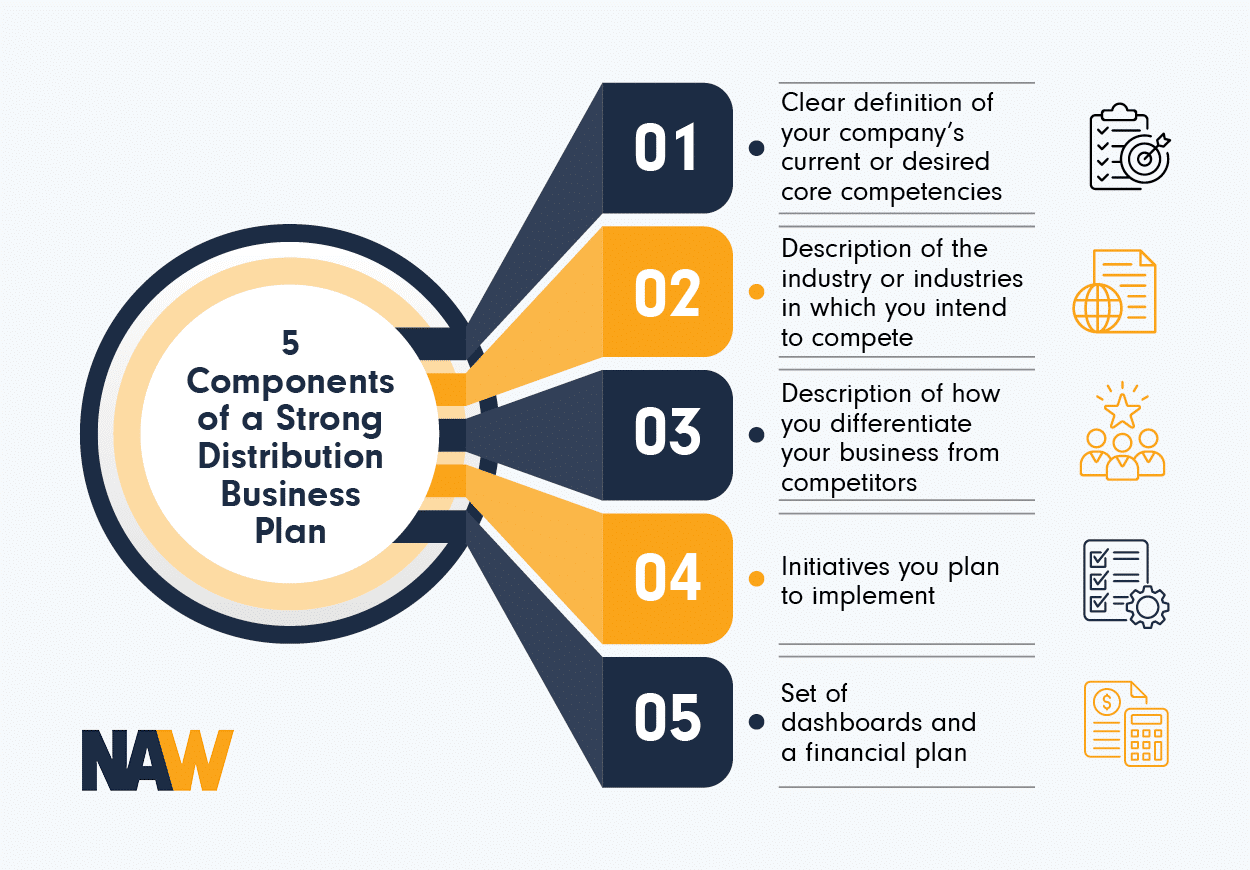
Let’s look at each of these components.
A core competency is something your business does well that is central to your operations. Typically, a core competency:
Distributors often have core competencies related to assortment, product availability, and technical expertise. You need to determine (preferably through quality research) which benefits your customers crave and then build the competencies you need to provide them.
For example, an industrial automation distributor might assume their competitive edge lies in maintaining a massive, 50,000-SKU inventory catalog. However, targeted customer research might reveal that what their clients actually struggle with is costly production downtime caused by improper part integration. This insight shows that integration expertise, rather than catalog size, is the competency worth investing in.
You need to be able to define exactly what kind of distributor you are. For example, do you define yourself by:
These are related, of course, but not the same.
This step sounds easy, but distributors are often so concerned about narrowing their focus that they fail to become really clear about what they want to do. Here’s a tip: start with a focused market. Once people understand you, you can broaden your target over time. But if customers do not “get” what you’re trying to be, you never gain traction.
For instance, a new regional electronic components distributor may start by marketing high-voltage wiring for renewable energy installers within a three-state radius. Once local solar and wind contractors recognize the distributor as the go-to specialist who understands their regulatory needs and keeps their specific parts in stock, the company can build a loyal, highly profitable customer base. With that strong market foothold and brand clarity established, the distributor can then safely and systematically broaden their target over time to include commercial HVAC or automation wiring.
Differentiation is about being the best at something. How are you going to beat the competition? No matter what core competencies you decide to build, other distributors in your market will have similar capabilities. In the strategic planning process, you need to decide how you will be different.
It takes a lot of hard work to come up with a great answer to this question and even more work to make that differentiation real. It’s easy for us to say that we will have superior technical expertise, for example, but it’s extraordinarily difficult to build it and maintain it.
To help determine your differentiators, try following these steps:
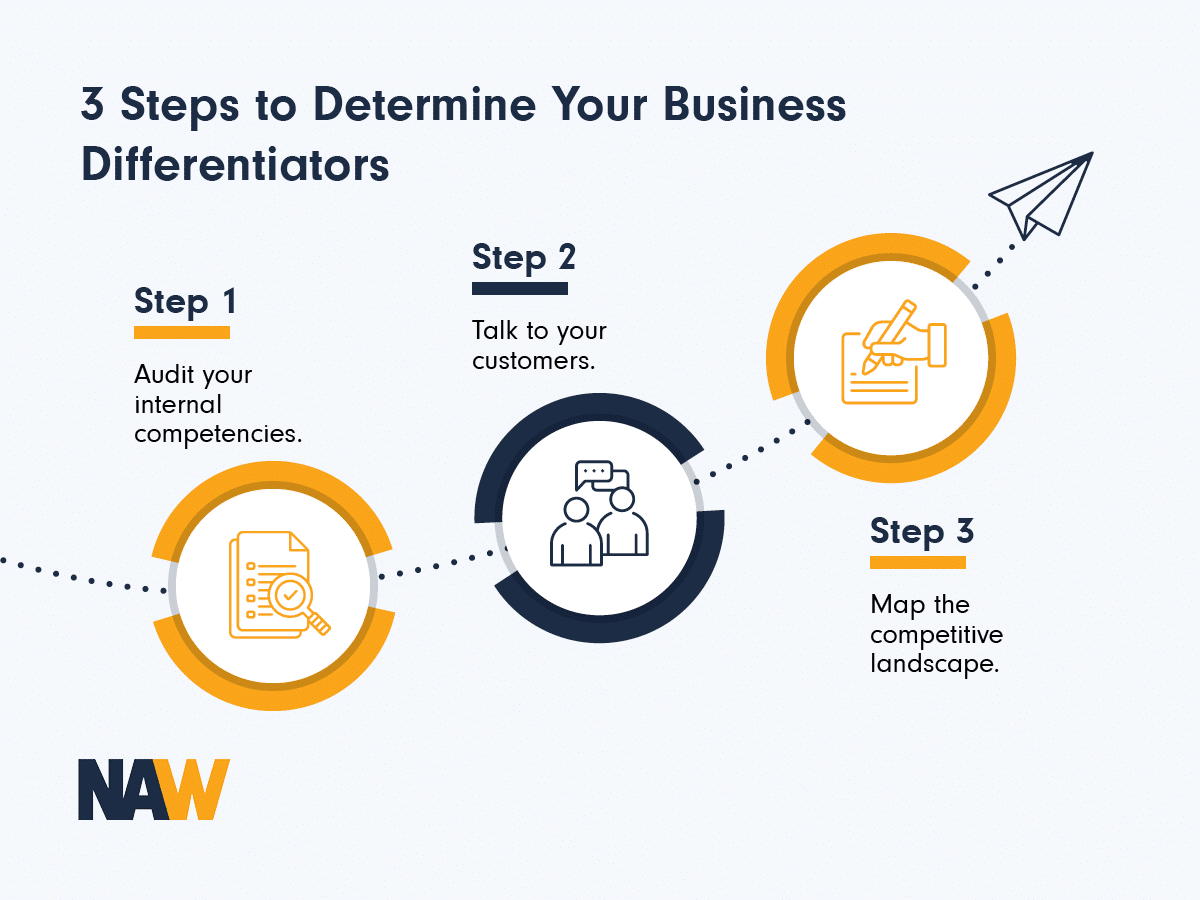
Throughout the process, make sure your differentiators are communicable. Your sales team should be able to explain any core advantages to prospects quickly and simply without using industry jargon.

This is where your strategy connects to your tactical plans. When a distribution executive complains that their strategy “gathers dust on a shelf,” it’s typically because their planning process ended at a very high level. They likely didn’t continue the process by assigning specific individuals and teams to develop tactics in each of these core areas:
The most common reason the strategy stops at a high level is that, at this stage, various leaders on the planning team start competing for resources. It’s just easier to let the old company politics and power struggles decide who gets what budget and headcount than it is to surface the disagreements and fight over resource allocation in public. Unfortunately, this often leads the company to pursue too many initiatives that haven’t been properly vetted or prioritized. It’s better to clarify the alternatives and make hard choices.
Your strategic planning process cannot be separated from your annual budget process. In the vast majority of companies, if it’s not in the budget, it doesn’t exist. That’s why you must have your CFO on your strategic planning team.
During the planning process, your team must compile a financial plan that estimates the results of implementing your strategy. This means modeling the cash flow impact and calculating how the new initiatives will affect your operating leverage over the next 12 to 36 months. Ultimately, the financial forecast will serve as the final stress test for your strategy: if the projected ROI does not meet the board’s or ownership’s requirements, you must revise the strategic plan before a single dollar is spent.
A budget only tells you what you can afford to spend this year. On the other hand, a strategic plan tells you where you should be pointing the company to grow. Without a distributor plan, departments often work in silos, and the company risks competing strictly on price rather than building long-term value.
While the executive leadership team (CEO, CFO, and VPs) owns the final plan, it should involve input from managers across all key operational areas, including sales, marketing, operations/warehousing, IT and human resources, ensuring that the final goals are realistic and executable for the whole team.
A core competency is an internal strength — something your company is exceptionally good at doing, like managing inventory or providing technical support. A competitive differentiator is how you use that strength in the marketplace to make a customer choose you over a competitor.
A strategic plan does not need to be a massive 50-page document. In fact, the most effective strategic plans are concise — often distilled down to a few pages or a single-page dashboard — so that every employee can easily understand the core mission and the annual initiatives they are responsible for executing.
Developing a detailed strategic plan is very difficult work. It’s frustrating to gain alignment between a group of strong-willed leaders. But that hard work and pain during planning will generate much better results for the rest of the year and beyond.
For more information on distribution business strategies, check out the following additional resources:


Stay Informed
News, trends, and analysis for wholesale distribution leaders. Free, everyday.
Subscribe to MDM Update