Economic Trends
U.S. Cutting Tool Orders Tick Down in August, Shipments Hold Steady
October 21, 2026


Economic Trends
It’s the latest economic indicator that demand remains subdued in the U.S. manufacturing sector.

The Institute for Supply Management released its monthly manufacturing Purchasing Managers Index (PMI) on Aug. 1 reflecting July activity, which showed a fourth straight monthly decline.
The PMI — regarded as a reliable indicator of overall U.S. industrial economic health — fell 1.7 percentage points from June to a mark of 46.8% and indicated that demand remains subdued in the manufacturing sector — which encompasses 10.3% of the U.S. economy — and at a further decelerated pace than earlier this past Spring.
Economists polled by Reuters had forecast a PMI increase to 48.8%.
The July PMI reading indicated contraction (anything below 50.0%) for the 20th time in the past 21 months.
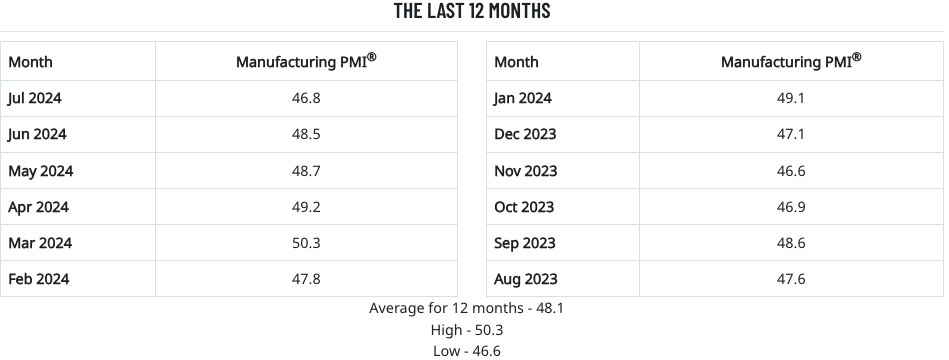
Of the July PMI’s 10 factoring indexes, five moved lower during July, and eight ended the month in contraction territory. The overall figure was driven down by declines of 1.9 points in new orders, 2.6 points in production and 5.9 points in employment.
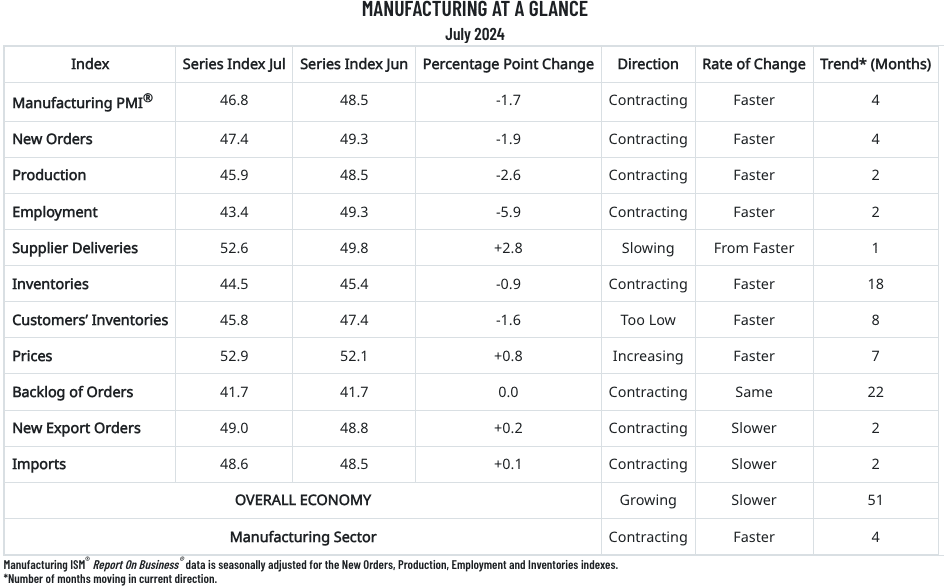
“Demand remains subdued, as companies show an unwillingness to invest in capital and inventory due to current federal monetary policy and other conditions,” ISM Manufacturing Business Survey Committee Chairman Timothy Fiore commented on the July report. “Production execution was down compared to June, likely adding to revenue declines, putting additional pressure on profitability. Suppliers continue to have capacity, with lead times improving and shortages not as severe.”
Fiore added that 86% of manufacturing GDP contracted in July, up from 62% in June and 55% in May. More concerning, he said, is that the share of sector GDP registering a composite PMI calculation at or below 45% — considered a good barometer of overall manufacturing weakness — was 53% in July, a 39-point jump from June.
All six of the largest manufacturing industries the PMI tracks — Machinery; Transportation Equipment; Fabricated Metal Products; Food, Beverage & Tobacco Products; Chemical Products; and Computer & Electronic Products — contracted in July.
The five manufacturing industries reporting growth in July were: Printing & Related Support Activities; Petroleum & Coal Products; Miscellaneous Manufacturing; Furniture & Related Products; and Nonmetallic Mineral Products.
The 11 industries reporting contraction in July were, in order: Primary Metals; Plastics & Rubber Products; Machinery; Electrical Equipment, Appliances & Components; Transportation Equipment; Fabricated Metal Products; Food, Beverage & Tobacco Products; Wood Products; Paper Products; Chemical Products; and Computer & Electronic Products.
Stay Informed
News, trends, and analysis for wholesale distribution leaders. Free, everyday.
Subscribe to MDM Update