


Expert Perspective
Preparing to Win in 2027: Three Distribution Leaders on the Year Ahead
Leaders from NAW members Motion, Specialty Building Products and Imperial Brady share how they’re preparing for 2027 amid improving demand and persistent operating pressures. Their perspectives highlight opportunities in reshoring, AI and productivity — and the execution needed to turn technology investments and acquisitions into stronger customer service and growth.
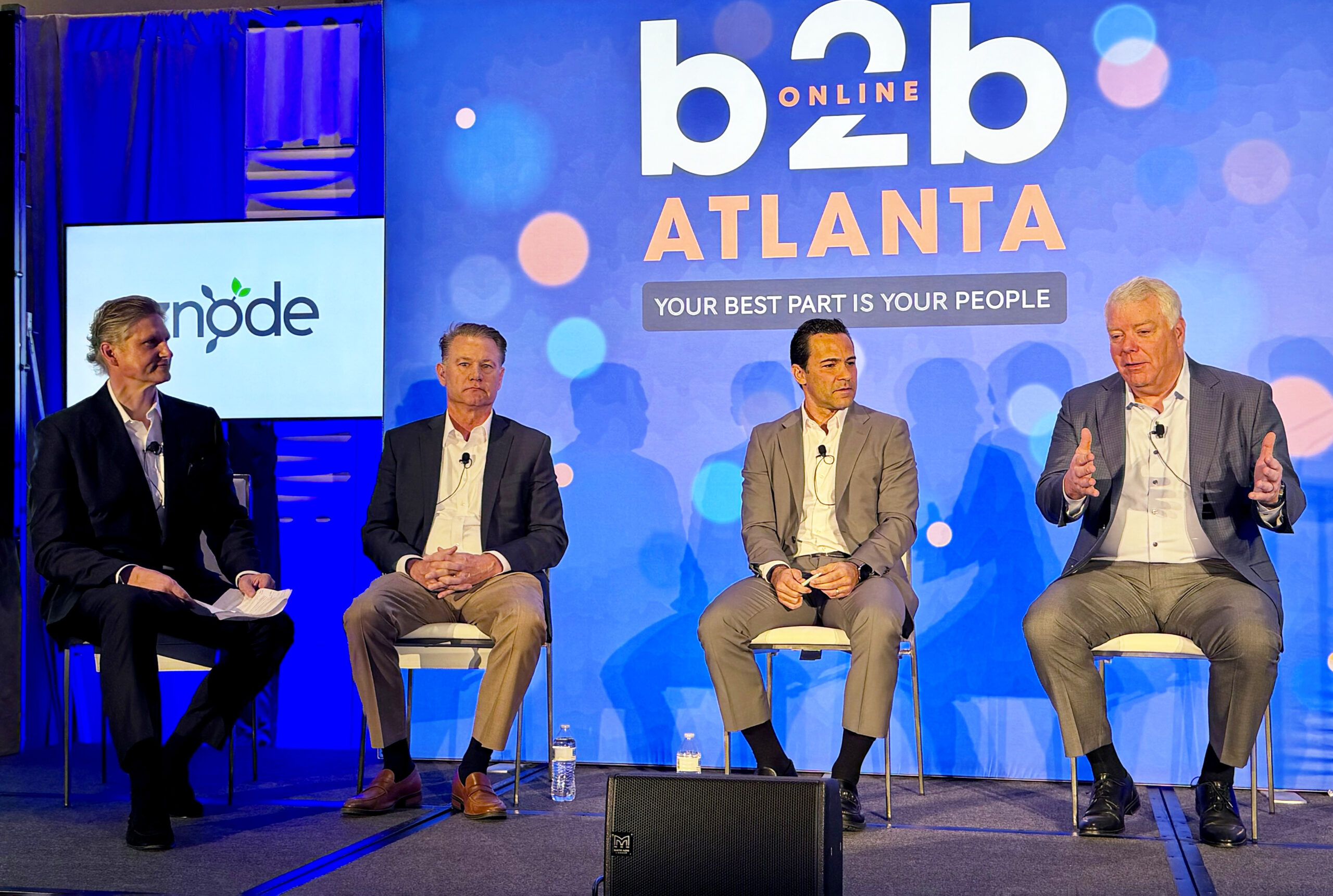
Lead image: From left, NAW CEO Eric Hoplin, Motion President and COO James Howe, Imperial Brady CEO Jason Tillis and Specialty Building Products CEO Jeff McLendon speak on a panel session during B2B Online Atlanta on Nov. 10.
Distributors have reason to enter 2027 with confidence, even as they face difficult decisions about where to invest. Growth has accelerated, but uneven demand, cost pressures and persistent hiring challenges continue to test how effectively companies can turn higher sales into better performance.
NAW’s 3Q26 MarketPulse report — based on the Baird-NAW Distribution Survey conducted in early October — captures that balance. Respondents reported 8.3% year-over-year revenue growth in the July-September period, up from 6.3% in 2Q, and projected 6.4% growth for 2027. Underlying demand improved, though pricing remained a meaningful contributor to sales gains. Respondent commentary pointed to strength in data centers and infrastructure alongside continued housing affordability pressures and challenges with transportation costs and labor availability.
That combination of opportunity and operating pressure framed a Nov. 10 panel at B2B Online Atlanta 2026. Three of wholesale distribution’s leading executives offered a confident but practical view of the year ahead, with a shared focus on turning investments in people, technology and capacity into results.
Moderated by NAW President and CEO Eric Hoplin, the discussion brought together Jason Tillis, CEO of Imperial Brady; Jeff McLendon, CEO of Specialty Building Products; and James Howe, president and chief operating officer of Motion.
Their outlooks reflected the different markets they serve. Howe sees opportunity in reshoring and automation. McLendon sees a need to expand capacity with fewer employees relative to the business’s size. Tillis emphasizes execution through whatever conditions emerge.
Motion: Follow the manufacturing investment
“We’re very bullish on the reshoring and nearshoring opportunity in North America right now,” Howe said.
Motion provides industrial products, engineered solutions and services to customers across automotive, mining, oil and gas, steel and food and beverage manufacturing. Its employees are embedded in customers’ operations, helping keep factories running.
Investment in manufacturing automation provides another tailwind. Howe described a shortage of factory-floor talent that is driving customers toward automation, creating opportunities for Motion’s business.
The company is also preparing to become an independent publicly traded business through its planned separation from Genuine Parts Company, targeted for the first quarter of 2027.
Howe paired optimism with readiness to adjust. Recent disruptions have reinforced the need to follow customer demand, while Motion’s diversified end markets help it navigate challenges in individual sectors.
“We’re an agile business and we’re going to keep investing and moving where the customers are,” he said.
SBP: Grow beyond the staffing constraint
McLendon approached the outlook from a building products market contending with housing and interest-rate pressures. His response focused on a broader challenge: finding enough drivers, warehouse employees, manufacturing workers and salespeople to support growth.
Businesses must figure out how to “run a business with less people compared to the size of our business,” he said.
That distinction is key. McLendon described productivity as a way to expand the business despite hiring constraints. His example involved using AI tools to improve loading across SBP’s flatbed fleet, where bulky products and complicated combinations of dimensions and weight make planning difficult.
Improving utilization could create additional delivery capacity from existing trucks and drivers. The value extends beyond cost savings to the ability to deliver customers’ orders.
SBP is also simplifying complex product decisions. Configuring an entry door can involve millions of combinations of components, with expertise historically concentrated in experienced employees. McLendon described “a little bit of a race to codify that industry knowledge” in tools customers and newer employees can use.
Those investments offer a practical response to a challenging market: make transactions easier, preserve expertise and help customers navigate complexity.
Imperial Brady: Execute regardless of the macro
Tillis framed the year ahead through management accountability.
“I think it’s our job regardless of the macro to perform,” he said.
His examples were concrete: interest-rate hedges when financing risks rise, sourcing alternatives when tariffs change and preparation to support customers through disruption. The emphasis was on building a business that can perform across conditions.
Imperial Dade and BradyPLUS completed their merger in March, creating the business now operating as Imperial Brady. For the distributor of foodservice, janitorial and industrial packaging supplies, integration represents a substantial opportunity.
“What we’re trying to build now is a platform that is big and fast,” Tillis said.
Standardized systems and warehouse tools can improve productivity and reduce errors. Tillis also emphasized protecting the customer relationships that made the acquired businesses successful, extending from salespeople and customer service to delivery drivers.
His example was a deli waiting for cups and lids: customers care about receiving what they need to operate. Scale must support that responsibility.
Technology and acquisitions: Deliver the value
The panelists described progress with AI alongside differences in its maturity. McLendon reported improvements in complex technology and data projects. Tillis emphasized faster, better-informed decisions. Howe saw a path to significant value while remaining cautious about declaring a step change.
Motion initially explored applying AI across an entire customer-service process. Numerous customer-specific exceptions prompted a shift toward smaller applications, allowing progress in individual tasks while retaining employees’ expertise.
That experience aligns with NAW’s 2026 AI Adoption Index, in which 47.4% of its some 300 respondents reported a moderate or significant effect on back-office efficiency. Meanwhile, 76.3% of respondents reported no workforce changes from AI. Together, the findings suggest that early gains can come through time saved and capacity added, reinforcing the panel’s focus on practical applications that help employees handle more work.
Acquisition integration requires similar judgment about where change creates value. Howe described preserving acquired capabilities when that serves the deal’s purpose and integrating systems when combining operations creates value. McLendon highlighted inherited technical debt and AI’s potential to accelerate the work required to address it.
A community for the challenges ahead
Hoplin connected these discussions to a familiar industry responsibility: customers turn to distributors when things go wrong. Preparation and resilience create opportunities to demonstrate that value.
The discussion also illustrated NAW’s role in bringing leaders together to share insights and tackle common problems. The panelists cited peer learning and advocacy as reasons they participate.
“I’ve learned something from every NAW event I’ve been to,” Howe said.
NAW is honored to count these companies among its members. Their leaders bring insight and innovation from distinct industry verticals, united by a focus on customers and results. As they prepare for 2027, that exchange of experience helps strengthen the industry’s capacity to meet what comes next.
“NAW brings together leaders from some of the largest and most successful distribution companies in the country to share insights, learn from one another and tackle common challenges,” Hoplin said. “We’re proud to have members like Jason, Jeff and James, who are leading their businesses with innovation and a fierce focus on customers and results.”