

Large Distributors are Gaining Pricing Power 6X Faster than You. Here’s the Data
This piece analyzes recent MDM survey data to compare pricing power divergence between large and small distributors. It's measurable, and most small companies haven't seen it yet, says author Nelson Valderrama.

Editor’s Note: Welcome to “The Hidden Majority” — a new column series from MDM authored by one of our top contributing writers, Nelson Valderrama. This series is all about providing thought leadership and industry analysis geared for small- to mid-sized distributors, which comprise the vast majority of the wholesale distribution landscape. Leveraging the latest quarterly Baird-MDM survey data, Nelson dives into the numbers and commentary to identify trends and takeaways that apply to SMBs in the industry.
The previous article in this series looked at the three causes of margin pressure for you: vendor cost increases, operating cost inflation, and pass-through fatigue. It’s a different fight than the competitive pricing war your larger peers face.
That article ended with a question the data raised but didn’t answer: “What’s happening to your pricing power while all of that cost pressure accumulates?”
The 1Q26 MDM/Baird Distribution Survey — conducted early April — asked distributors directly. The answer is worse than most sub-$100M distributors realize.
Where This Data Comes From
If you want to know where you stand, check out the results of the Q1 2026 MDM/Baird survey. It asked a single, critical question: “How does your pricing power compare to a year ago?” to which 143 of your peers responded. You’ve seen the options: stronger, about the same, or weaker. When you break these results down by company size, you’ll see the gap is immediate—and large.
The 27-Point Gap
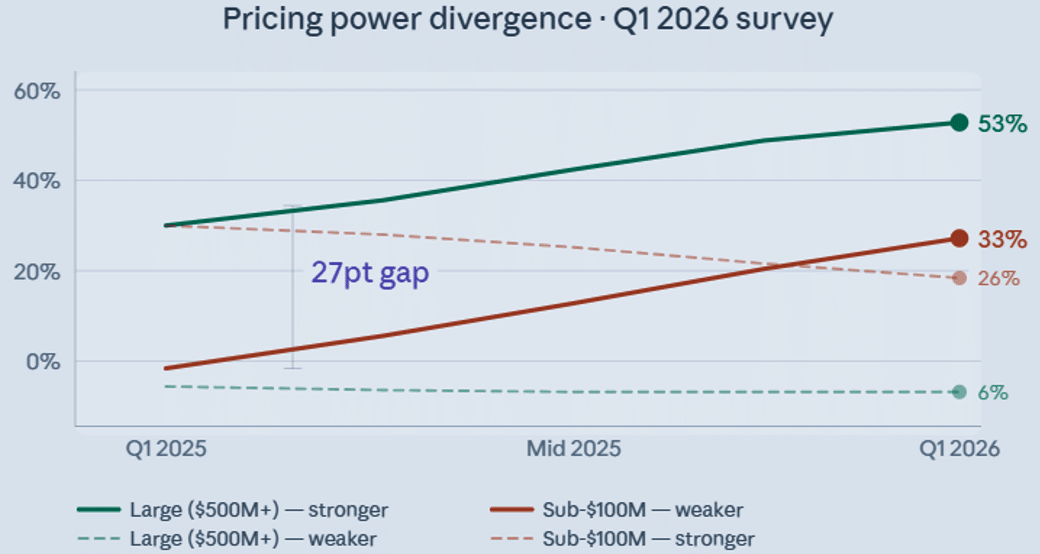
Among the largest distributors ($500M+ revenue), 53% report stronger pricing power than a year ago, while only 6% say it is weaker.
Only 26% of sub-$100M distributors report stronger pricing power, and 33% say it has weakened. This 27-point gap reveals a stark deviation. Larger distributors secure pricing power six times faster than you, while smaller firms lose it at five times the rate of their larger rivals.
The middle category (“about the same”) is nearly identical at 41%, but that tells the real story. As larger distributors move toward stronger power, you’re being pushed toward weaker. If you fall into that middle category, ask yourself if you simply haven’t measured the erosion yet.
Yours Isn’t a Micro Problem
Micro distributors (under $25M) and Small distributors ($25–$100M) typically diverge on key issues like succession planning, technology investment, and AI adoption. Despite both being under the $100M threshold, when you look at pricing power, you find they don’t diverge.
Micro distributors report weaker pricing power at 30%, while Small distributors sit at 38%. This narrow difference confirms that pricing erosion is not just for the smallest player; it is a shared struggle across the entire sub-$100M segment.
This matters for your business because it proves the problem isn’t just about scale. A $60 million distributor with 40 employees and three branches is losing pricing power at roughly the same rate as a $12 million distributor with a single location. The core mechanism is the same for all of you. It involves vendor costs imposed from above, customers resisting from below, and no systematic way for you to optimize what sits in between.
The Compounding Effect
You saw in my previous article that 31% of sub-$100M distributors absorbed at least a portion of tariff-driven cost increases in 2025, compared to only 18% of larger distributors. A year later, your cost-absorbing peers are the ones reporting weaker pricing power.
This is the compounding effect you face: you absorb costs in Year 1, and you lose pricing power in Year 2. Your customer got used to the price you held firm. The vendor kept raising costs on you. And now you’re trying to pass through increases to customers who already believe your prices are as high as they should go.
- “Distributors will begin lapping initial tariff price increases taken in 2025 soon. This will affect margin, especially those that took FIFO timing benefits last year.” — Distributor, <$10M annual revenue in 1Q26 MDM Survey
The tariff lapping risk compounds your pricing power erosion. Your temporary margin buffer from pre-tariff inventory is gone. Your replacement inventory now carries the full tariff cost. And your customer’s reference price is the one you set when you were absorbing costs to keep their business.
One $10-$25M distributor described the endpoint of this cycle: “Being a small fish in an ocean is very hard for us to compete as our competitors have much stronger buyer power than we do.”
That’s not a temporary market condition for you. That’s a structural disadvantage that widens every quarter your pricing power goes unaddressed.
Another <$10 million distributor, operating across multiple regions, described the same dynamic from the pricing side: “The market is much tougher on pricing. We are having to leverage our scale against manufacturers to keep margins equal.”
“Leverage our scale” — from a distributor under $10 million.
That’s the language of a business that knows it’s losing the leverage game but hasn’t found another way to play it.
What Your Larger Competitors Do Differently
When you look at the contrast in the data, it isn’t just about the size of the business. It’s about your approach to the market.
Notice how differently your peers in the over-$100M segment described their pricing environment in the 1Q26 survey:
- “So far we have been able to maintain margins and push through increases we have received. I expect that this will continue for now.” — $101–$250M revenue distributor
- “As our equipment OEMs see their volumes decline, and we see our volumes increase, our pricing power has increased.” — $101–$250M distributor
- “We had to revise our strategies in order to bring our new price lists to market more quickly and to move toward a more imposed pricing approach rather than negotiating pricing.” — 101–$250M distributor
You also need to pay attention to the last quote. “A more imposed pricing approach rather than negotiating.” This distributor didn’t gain pricing power simply by getting bigger; they gained it by systematizing their pricing. They moved from the case-by-case negotiation that likely drains your time and margin to a structured, data-driven approach that gets price lists to market faster than you might think possible.
Meanwhile, you and your sub-$100M peers are often stuck describing the opposite experience:
- “Competitors are desperate and rather than focus on adding value, just continue to race to the bottom.” — <$10M distributor
- “Margins are dwindling due to competitive pricing from distributors coming into our market from much greater distances than in the past.” — $10–$25M distributor
One $26-50M distributor pointed to a third path you might recognize—using differentiation as pricing protection: “We are leading edge on value-added distribution. Our capabilities are the best in the market. It protects our margin to some degree. To get business from us our competition must sell for less. How smart our competition is about how low they will go is mind-boggling. They drop way down when they don’t need to.”
Even for this distributor — one with clear differentiation and market-leading capabilities — margin protection is only partial. Differentiation slows your erosion, but it won’t stop it. The pricing power gap you’re seeing isn’t destiny, but closing it requires more than just being good at what you do. It requires you to systematize how you capture the value of the work you perform every day.
Where This Leads You
Across this three-part series, we’ve traced a clear line through the data that directly impacts your business.
In the first article, we revealed that while you likely already use AI, you probably aren’t applying it to pricing. Among your sub-$100M peers, only one in 62 mentioned pricing as an AI initiative, focusing instead on chatbots, emails, and office administration. This means you are sitting on a massive, uncaptured opportunity. Specifically, 73% of distributors expect pricing AI to deliver over 2% margin improvement, yet only 16% have achieved it. [See: “Your AI Is Writing Emails. Your Competitor’s AI Is Finding Margin.”]
The second article showed you why this is urgent. You are fighting a different margin war than your larger competitors, one defined by rising vendor and operating costs. With pass-through fatigue setting in and tariff lapping on the horizon, you can no longer afford to ignore the structural cost advantages your bigger rivals are leveraging. [See: “Vendor Costs Are Eating Your Margin. Your Bigger Competitors Don’t Have That Problem.”]
This third article completes the picture. Those cost pressures are doing more than squeezing your margins; they are actively eroding your pricing power. This erosion creates a cycle that makes escaping cost pressure even harder.
To break this cycle, you shouldn’t just try to negotiate harder with vendors. Instead, you must systematize the one lever you actually control — how you price. The technology you need is accessible to you right now, in the same form used by multi-billion dollar corporations. Your path forward isn’t limited by technology, but by how you apply it. The margin you’ve been looking for is already in your data.
You just have to go find it before someone else does.
Data sources: MDM/Baird Industrial Distribution Survey Q1–Q4 2025 (n=577 across four quarters) and Q1 2026 (n=143); NAW/MDM “In Pursuit of Value: Where 400+ Distributors Are Investing in AI” (April 2026, n=426).