
Technology Provider News
Epicor Debuts Agentic AI Platform, Promises 90-Day Cloud ERP Deployments
May 19, 2026


ERP
At SuiteWorld 2026, Oracle NetSuite outlined how AI agents, natural-language workflows and a more connected technology stack could reshape distributor operations. Its latest innovations target inventory management, fulfillment and ERP implementation, while raising important questions about adoption, data quality and how much authority companies should delegate to automation. Here's our key takeaways from the event.
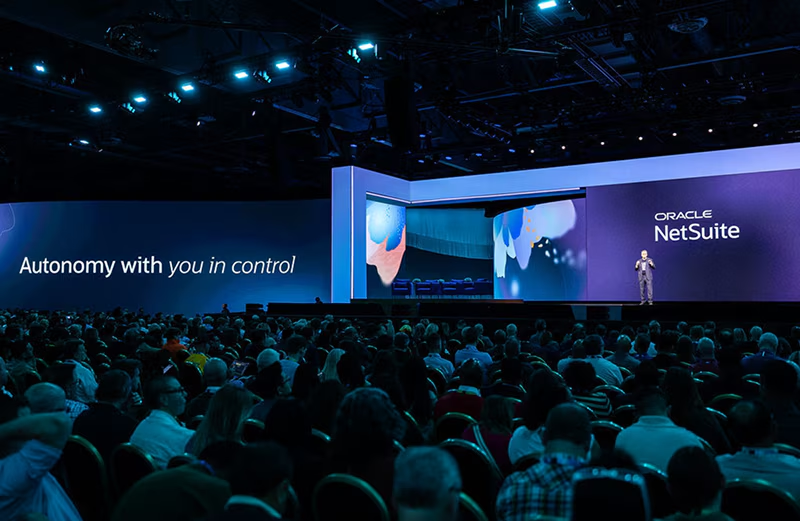
Lead photo: NetSuite Co-Founder and CEO Evan Goldberg addresses more than 8,000 SuiteWorld attendees with the event’s opening keynote on Oct. 26 in Las Vegas. (NetSuite photo)
Oracle NetSuite used its annual SuiteWorld conference to present a vision of enterprise resource planning (ERP) software that moves beyond recording transactions and providing business intelligence to increasingly anticipating problems, coordinating workflows and taking action on behalf of users.
For wholesale distributors, that evolution could change how companies manage inventory, purchasing, fulfillment, customer relationships and other core operations — and how they structure their technology ecosystems.
Throughout the Oct. 25-28 event, held alongside Oracle AI World in Las Vegas, NetSuite executives repeatedly emphasized the notion that it’s “the end of ERP as we know it,” whether from the keynote mainstage or the numerous breakout and workshop sessions throughout the Venetian Expo. The message wasn’t that ERP software is becoming obsolete, but that artificial intelligence is fundamentally changing how employees interact with it and what the software can accomplish.
At the center of that transition is NetSuite Next, the company’s latest-generation platform, which incorporates conversational AI, agentic workflows and increasingly autonomous capabilities into its existing cloud-based ERP environment.
NetSuite founder and Executive Vice President Evan Goldberg has positioned this transition as a potential competitive equalizer for smaller and midsized businesses. In messaging leading up to SuiteWorld and during the event, he emphasized that AI is eroding some of the historical operational advantages enjoyed by large enterprises, which have traditionally possessed the resources to invest in sophisticated systems and specialized personnel.
His broader premise is that AI could enable smaller organizations to operate with greater sophistication and efficiency without requiring comparable increases in staffing, systems or administrative complexity.
“We are witnessing the end of the enterprise advantage as we’ve known it,” Goldberg told the more than 8,000 attendees in Las Vegas from the massive keynote mainstage. “The next generation of market leaders won’t look like enterprises. They’ll have the best of both worlds: the power of a large company, and the speed and agility of one a tenth the size.”
For distributors operating on thin margins and competing against significantly larger rivals, that ambition has considerable implications.
Get NAW’s 2026 AI Adoption Index Report
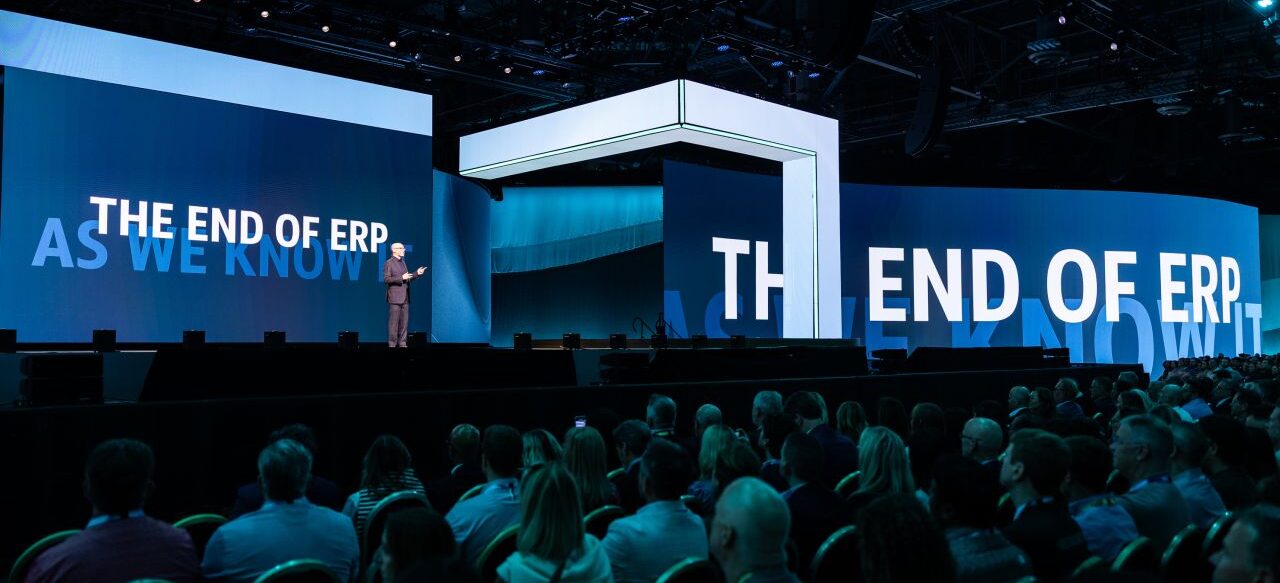
NetSuite’s vision centers on an ERP platform that understands the relationships among financial transactions, inventory, sales, customers and business operations, then uses that context to identify problems and help resolve them.
Rather than requiring employees to navigate multiple screens, run reports and manually initiate subsequent tasks, the company envisions AI agents that continuously monitor business activity and coordinate actions within established permissions and approval requirements.
During SuiteWorld, NetSuite introduced several capabilities intended to advance that approach:
NetSuite said SuiteSkills, AI Portlets, AI Workspaces and select industry-specific SuiteAgents are available in markets where NetSuite Next is offered. Other capabilities, including additional agent-building and management tools, are planned for future releases.
NetSuite already offers wholesale distribution capabilities spanning inventory management, purchasing, order processing, warehouse operations, supply chain management, financial reporting and customer relationship management. Its latest AI strategy builds on those existing functions, with the objective of making their underlying data and workflows more accessible and increasingly automated.
Inventory management offers one of the clearest potential applications. Distributors routinely balance product availability against carrying costs, supplier lead times, demand fluctuations and inventory distributed across multiple locations. Evaluating those conditions often requires employees to combine data from several business functions.
NetSuite’s Product SuiteAgent is intended to help organizations monitor inventory exposure and supply changes, assess their implications and recommend appropriate responses.
The company has not announced a dedicated wholesale distribution SuiteAgent, but the broader product-focused capabilities could be applicable to many distributor operating models.
Other SuiteSkills target fulfillment exceptions, helping teams investigate delivery delays or inventory imbalances and determine possible next steps.
The envisioned progression is from identifying an operational problem to helping coordinate its resolution, potentially reducing the manual analysis and administrative work required of purchasing, warehouse and customer service employees.
For example, an AI-enabled workflow could potentially flag an emerging inventory shortage, identify affected customer commitments and surface possible replenishment or fulfillment alternatives for review. However, the extent to which such activities can be executed autonomously depends on the specific tools, configurations and permissions available.
The company also sees opportunities to improve financial management by linking operating conditions to their financial consequences, including revenue leakage, working capital pressures and margin performance.
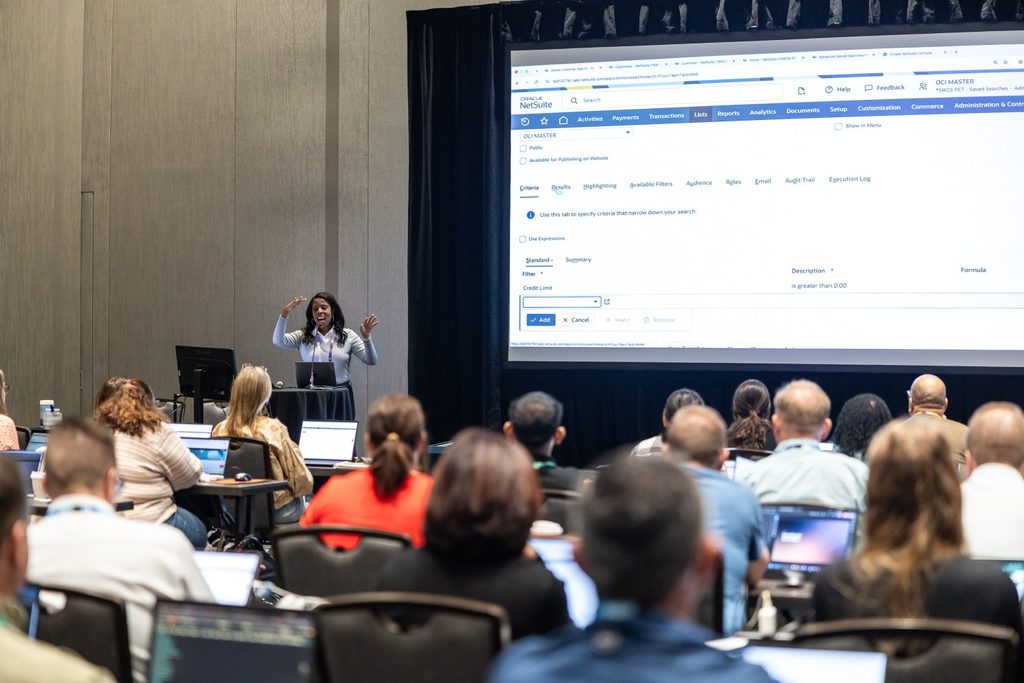
Another significant component of NetSuite’s approach is its emphasis on allowing businesses to use AI services beyond those embedded directly within its software. The NetSuite AI Connector Service enables customers to connect supported external large language models to NetSuite information and tools, subject to established user roles and permissions. NetSuite said more than 13,000 customers have adopted the service.
Meanwhile, planned Ask Oracle Connectors will expand how its conversational assistant interacts with outside applications and information sources. Using Model Context Protocol (MCP) capabilities, Ask Oracle is intended to access information across supported business systems, compare records, retrieve external information and initiate permitted actions in connected applications.
NetSuite also introduced enhancements to NetSuite Data Intelligence, formerly NetSuite Analytics Warehouse, to enable more conversational analysis and AI-driven business recommendations.
Collectively, the approach positions ERP as more than a financial and operational system of record. It also establishes a potential foundation for coordinating AI-driven work across applications.
That could be especially relevant to distributors whose technology environments increasingly include specialized eCommerce, warehouse management, product information management, pricing and customer engagement systems. Rather than requiring every function to reside inside one application, NetSuite’s strategy allows its underlying business data and permissions to support AI interactions across a broader ecosystem.
The company maintains that connecting AI to reliable business context is critical to producing accurate insights and appropriate actions. Its integrated ERP model is intended to provide that context by maintaining relationships among transactions, inventory, customers and financial performance.
NetSuite’s SuiteWorld announcements extended beyond how organizations use ERP after deployment. The company introduced SuiteExpress — an AI-enabled implementation toolset and methodology intended to reduce the time and manual effort required to configure and adopt its software.
SuiteExpress combines customer-specific information — including documents, spreadsheets, recordings, existing system data and business requirements — with NetSuite’s product and industry knowledge. AI can then assist with requirements gathering, data migration, configuration recommendations, workflow validation and employee training, with implementation consultants overseeing decisions and exceptions.
NetSuite maintains that the approach could reduce some implementations to weeks or even days, while helping existing customers adopt additional capabilities as their businesses evolve.
The initial rollout is limited to software industry customers in North America, according to reporting by CIO, with expansion to other industries and markets planned for 2027.
For distributors, the longer-term potential is meaningful, given the complexity often associated with migrating extensive product catalogs, customer-specific pricing arrangements, supplier records, warehouse configurations and transactional histories. However, the extent to which AI-assisted implementation can accelerate more complex distributor deployments remains to be demonstrated.
NetSuite’s autonomous ERP ambitions also place greater importance on oversight, security and accountability. As AI systems progress beyond answering questions and making recommendations, their ability to initiate transactions or modify business records introduces additional considerations.
For distributors, those actions could eventually involve purchase orders, inventory allocations, pricing changes, credit decisions and customer commitments — processes where mistakes could carry significant financial or operational consequences.
NetSuite says its AI capabilities operate within established roles, permissions and approval requirements. Its planned SuiteAgent Management Workspace is intended to provide centralized monitoring, execution controls, activity alerts and traceability of record changes.
Similarly, SuiteAgent Studio is designed to let organizations configure the instructions, tools, triggers and execution roles assigned to individual agents.
These safeguards reflect NetSuite’s broader philosophy of allowing AI to assume more operational work while preserving human oversight of consequential decisions.
Still, customers will need to evaluate which actions should remain subject to explicit approval, what transaction limits apply and how automated activity is monitored. Those questions become increasingly important as distributors begin connecting external AI services to ERP data and extending agent capabilities across their technology stacks.
NetSuite’s announcements reflect a broader transformation in enterprise software, with AI becoming an increasingly central interface between employees, business information and operational workflows.
For distributors, the company’s longer-term vision suggests that ERP systems could evolve from applications employees must continually operate into platforms that proactively surface issues, prepare decisions and execute authorized tasks.
The potential value extends beyond individual productivity improvements to better coordination across procurement, inventory, fulfillment, sales and finance.
Whether that vision translates into measurable operational gains will depend on the maturity of the tools, the quality of each company’s underlying data and its ability to integrate AI capabilities into established business processes.
With more than 44,000 customers worldwide, NetSuite is positioning its integrated platform and growing AI ecosystem to support that transition.
“For too long, running a business has meant choosing between the urgent and the important,” Goldberg said at SuiteWorld. “Approvals, reconciliations, reporting and countless routine tasks consume time that could be spent developing products, serving customers or pursuing new opportunities. AI gives us the ability to reverse that.”
The central question for distributors is no longer simply what information their ERP can provide, but increasingly what work it can reliably perform with that information.
NetSuite’s SuiteWorld messaging points toward a meaningful shift in how distributors should evaluate ERP platforms. Traditionally, the emphasis has been on functionality, integration and reporting. Increasingly, it will also be about how effectively those systems support AI-driven workflows that cross departmental boundaries.
The near-term opportunity isn’t necessarily fully autonomous purchasing or fulfillment. It’s reducing the manual effort involved in identifying exceptions, connecting operational data and preparing decisions.
But greater autonomy also raises the stakes for data quality, governance and integration architecture. Distributors should evaluate these tools based on measurable improvements in service levels, working capital and employee productivity — while distinguishing capabilities available today from those still on vendor roadmaps.

Stay Informed
News, trends, and analysis for wholesale distribution leaders. Free, everyday.
Subscribe to MDM Update