




Expert Perspective
AI and Leadership Takeaways from the ISA Fall Summit
Longtime industry executive and thought leader John Gunderson shares observations on AI adoption, pricing, customer service and leadership from the industrial supply channel’s recent gathering in San Antonio.
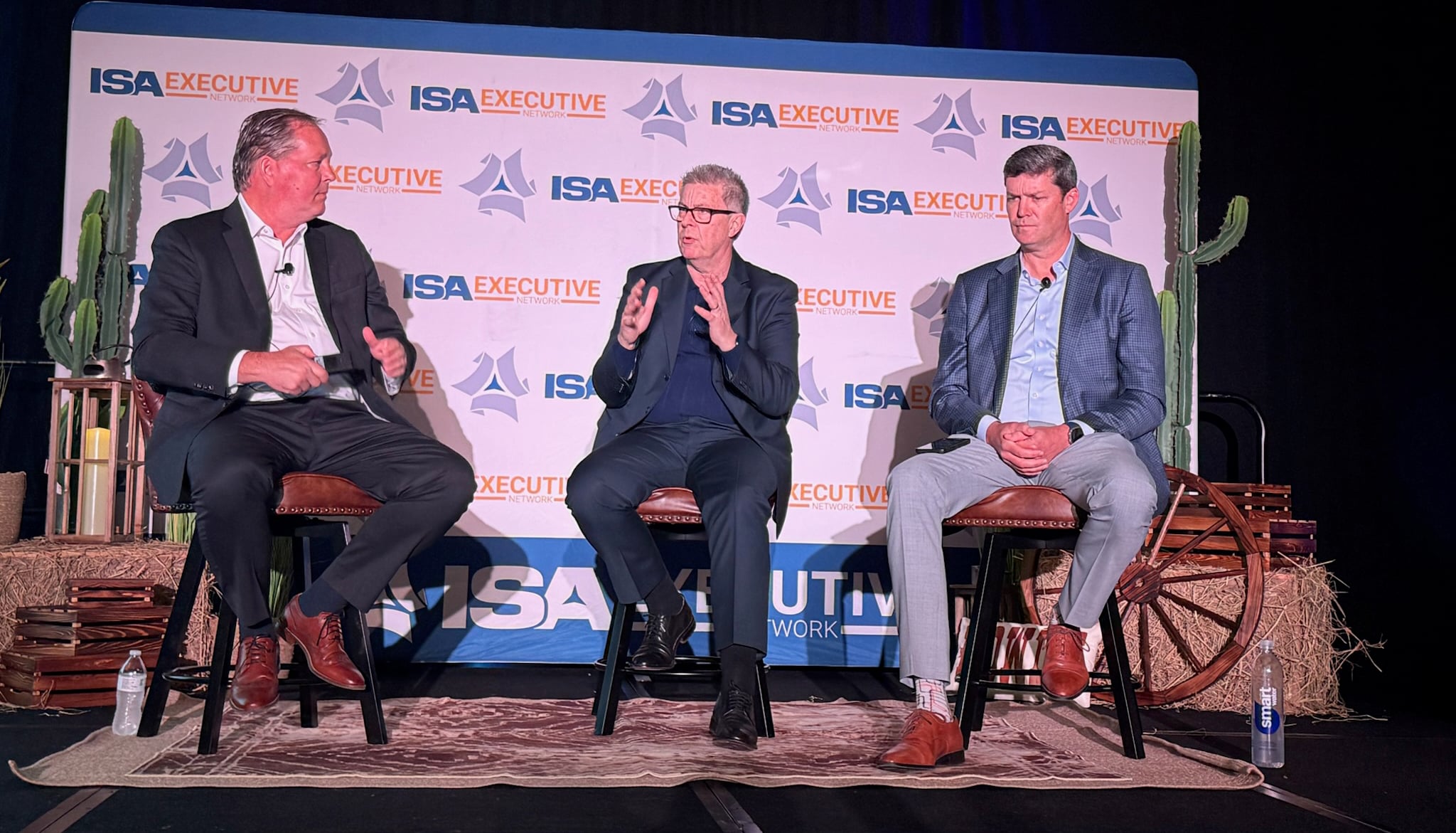
Lead image: The panel of (from left) ISA Director of Distribution Strategy John Gunderson, Ferguson Director of Enterprise Solutions Philip Robbins-Jones and UDig Executive Vice President Gordon Kelly speak during ISA’s Fall Summit on Oct. 27 in San Antonio. (ISA photo)
AI was everywhere at the Industrial Supply Association’s Fall Summit, but the conversations kept coming back to a familiar question: How do we use new tools and better processes to serve customers more effectively?
The Oct. 26-28 event in San Antonio brought together industrial distributors, manufacturers and manufacturers’ representatives. This was my sixth ISA event, and I spent most of my time in the Executive Network track, listening to peers discuss how they are adapting their businesses.
MDM’s relationship with ISA goes way back, as Rusty Duncan — MDM’s publisher for eight years in the 1990s — was the president of ISA’s past iteration, I.D.A., in 1989-1990. MDM continues to be represented in attendance at ISA’s spring conference each year, which included Executive Editor Mike Hockett speaking on the main stage this past April.
What stood out at the Fall Summit was how much the AI conversation has moved toward practical applications, alongside a continued emphasis on leadership, pricing and relationships. This has likewise been reflected in NAW’s 2026 AI research, with the latest iteration being the group’s AI Adoption Index.
With the ISA event fresh in mind, here are the takeaways I brought home.
Takeaways for the Industrial Channel
- The AI conversation is moving from whether to how. The “wait-and-see” approach was much less evident among the channel partners I spoke with. The question now is how to apply AI to each company’s specific business. Executives are moving at different speeds, from aggressive adoption to more measured approaches, but the discussions increasingly center on practical uses.
- Inside sales and customer service are changing quickly. I moderated a session with executives from UDig and Ferguson on how Ferguson is incorporating AI into its inside sales workflow to serve customers more efficiently. Across the channel, companies are using AI and process changes to improve pricing, sales and inventory. Much of this work is about optimizing the business already in place. AI, Amazon and inflation are accelerating change, and companies that put off automation where it makes sense risk falling behind.
- Risk planning is becoming part of the job. Alex Chausovsky’s “War Games for the Channel: Geopolitical Risk and Scenario Planning” session captured the challenge. Leaders need to plan for continuing disruption and recognize opportunities in change. The “war games” mindset is here to stay: Planning for risk needs to be an ongoing discipline.
- Pricing changes create opportunities. Inflation and frequent price adjustments add work, but they also create openings for companies prepared to respond. My advice is to meet those opportunities with enthusiasm and effort. Businesses overwhelmed by the workload risk falling behind competitors that are improving their pricing processes. Change requires an active response.
- Future leaders need to understand customers, operations and technology. Associates who combine a customer focus with operational knowledge and an understanding of technology will help lead the channel forward. Developing that combination should be a priority for today’s leaders.
- Leadership requires more than giving directions. Are you a leader, or a director with minions? As in, are you developing people, or simply telling them what to do? Leadership and mentorship were recurring themes, with Chuck Delph of Vallen and relatively new MSC Industrial Supply CEO Martina McIsaac among the speakers whose sessions attendees kept talking about. Building stronger companies requires investing in the people who will lead them.
- Communication needs to be relentless. Your team and channel partners should understand your goals, philosophy and culture. Do your partners know what makes you different from the competition? Don’t assume your employees know how much you care, how the team is growing or what you are working toward together. The desire for communication and feedback often exceeds what people actually receive.
- Customer support remains a differentiator. Channel partners are doubling down on the places where their people make a difference. What can I do while standing at the spindle with a customer or walking the factory floor to provide more value? Value-added services remain a foundation of the business, even as those services evolve.
- The outlook I heard for 2027 was positive. The economic forecasts and conversations at the summit pointed toward a growing industrial market next year.
Relationships and the Next Generation
One of the things I value about this gathering is the opportunity to hear from distributors, manufacturers and manufacturers’ reps in the same room. Those different perspectives matter when the discussion turns to how the channel can better serve end customers. Many events are distributor- or manufacturer-exclusive (or dominated by one group) with very little manufacturer rep involvement. At ISA, you’ll see 3M, Durrie Sales and MSC Industrial Supply, for example, all sitting at tables together and attending the same content sessions.
Bill McEllaney of Cutler Industrial Sales put the relationship between technology and people into perspective: “My biggest takeaway from the ISA Fall Summit is that while AI and technology are changing how we operate, relationships, trust, and the ability to create demand remain the foundation of success in industrial sales. Equally important is investing in our people, sharing knowledge across generations, and embracing tools that free up time to focus on what matters most — our customers and growing the business.”
That emphasis on sharing knowledge across generations resonated with me. The range of backgrounds and experience among attendees, including those participating in the Women in Industry and Emerging Leaders programs, was encouraging. It was good to see emerging leaders recognized during the opening general session and to hear the attention given to mentorship throughout the event.
It’s energizing to have the industry’s future in the room. The work is to keep investing in those people and communicating clearly once everyone is back at their businesses.
As my first mentor taught me, “In the absence of communication, people make up their own reality.” That remains useful advice as we close 2026 and prepare for 2027.
John Gunderson is director of distribution strategy at the Industrial Supply Association and a longtime distribution executive and MDM contributor. He formerly was MDM’s Vice President of Analytics.