





Economic Trends
First Estimate: 3Q U.S. GDP Growth Accelerated to 3.4%
The U.S. economy picked up speed in the third quarter, with investment and consumer spending supporting growth. Stronger private domestic demand and slower inflation offered encouraging signals, though inventory gains warrant a closer look.

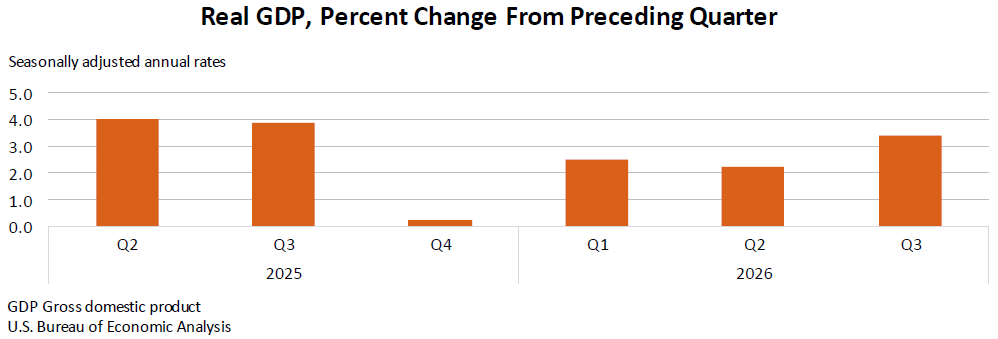
The U.S. economy expanded at a 3.4% annual rate in July-September, according to the Bureau of Economic Analysis’ advance estimate released Oct. 29. That marked a 1.2-percentage-point acceleration from 2Q’s 2.2% growth.
Economists surveyed by The Wall Street Journal had expected 3Q GDP growth of 3.1%.
Investment, consumer spending and government spending contributed to the expansion. Declining exports and rising imports — which are subtracted in calculating GDP — weighed on the result.
Faster investment growth and a rebound in government spending drove the acceleration. Inventory gains centered on wholesale trade and manufacturing, particularly nondurable goods. Equipment investment was led by computers and related equipment.
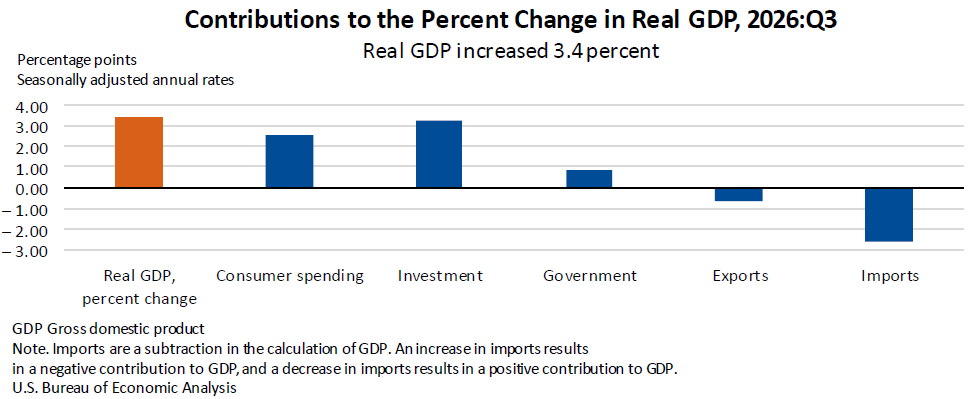
Consumer spending gains included health care, food services and accommodations and prescription drugs.
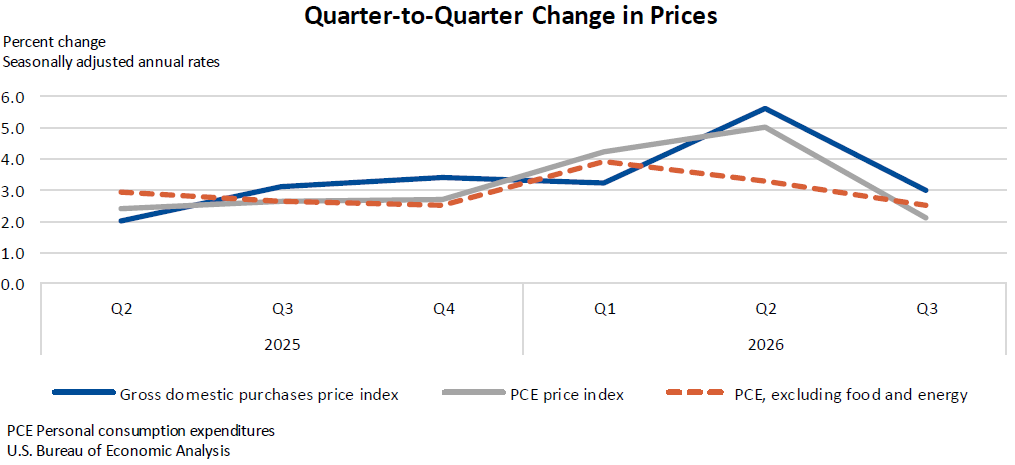
Real final sales to private domestic purchasers — consumer spending plus gross private fixed investment — rose 4.9%, up from 4.6%. Inflation measures slowed across the board.
Real GDP and Related Measures
Percent change from the preceding quarter, seasonally adjusted at annual rates.
| Measure | 2Q26 Final Estimate | 3Q26 First Estimate |
|---|---|---|
| Real GDP | 2.2% | 3.4% |
| Current-dollar GDP | 8.5% | 5.6% |
| Real final sales to private domestic purchasers | 4.6% | 4.9% |
| Gross domestic purchases price index | 5.6% | 3.0% |
| PCE price index | 5.0% | 2.1% |
| PCE price index excluding food & energy | 3.3% | 2.5% |
BEA will release its second estimate Nov. 25.
MDM Analysis
For distributors, stronger private domestic demand alongside slower inflation is an encouraging combination. The inventory contribution requires more scrutiny: Stockbuilding can reflect confidence in future sales, but it can also signal goods accumulating faster than customers need them.
The practical takeaway is to test the national growth story against order volumes, inventory turns and customer backlogs before expanding stock commitments. Slower price increases also make unit volumes more important when assessing sales performance. This report supports a more constructive demand outlook, while leaving room for significant differences across distribution end markets.