



AI
Why Distribution’s AI Bottleneck Isn’t Budget
The companies moving beyond isolated pilots are building a repeatable operating foundation around data, integration, governance and measurable business ownership.

Access to AI has never been easier. Distributors can test a new tool in minutes, add an AI feature through an existing software provider or launch a pilot without assembling a data science team.
Yet easy access has not produced broad scale.
NAW’s inaugural 2026 AI Adoption Index, developed in partnership with Infor, found that 68.1% of respondents who ranked adoption barriers placed data quality and integration among their top three. Talent and skills followed at 60.1%. Budget ranked a distant sixth at 27.5%.
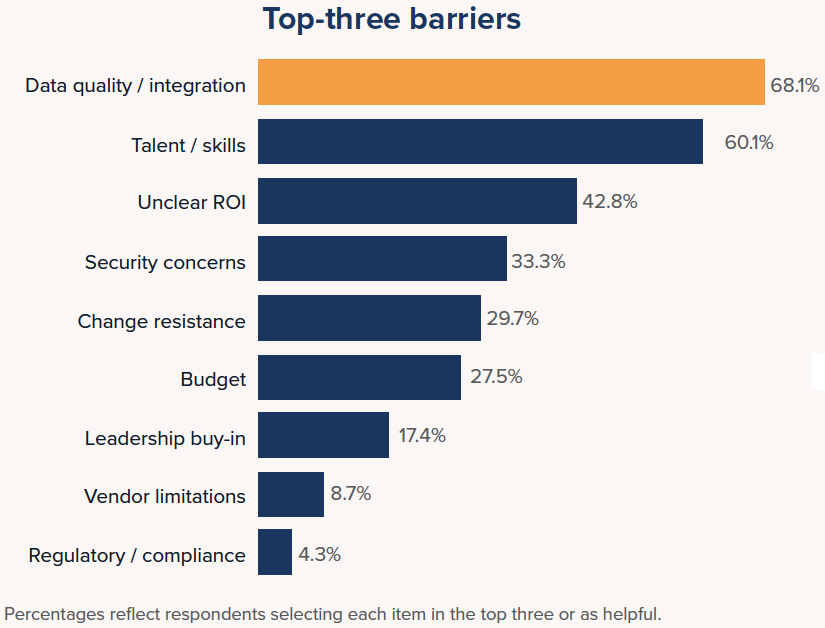
The constraint is not simply the checkbook. It is the operating foundation around the technology.
The Index shows that only 32.2% of respondents have a formal AI policy or governance framework in place. Just 39.4% have completed a formal inventory of their data assets, while 36.5% reported no integration between AI tools and a core business system.
Those gaps help explain why the industry has plenty of AI activity but far fewer repeatable operating capabilities.
Infor President and Chief Technology Officer Soma Somasundaram describes the necessary foundation as a three-part system: accessible data, an interoperable application environment and a governed process for deciding which AI tools can be used and how.
“Having access to data in one place is foundational for repeatability,” Somasundaram says about the research results.
That does not mean every distributor must first complete a massive data lake project or perfect every record across the enterprise. The more practical goal is to make the data required for a chosen workflow accessible, trustworthy and usable. AI itself can help identify duplicates and harmonize inconsistent records, but the company still needs ownership, permissions and a defined business process.
Integration is the next dividing line.
“A standalone tool can effectively answer a question,” adds Infor Vice President of Enterprise Architecture Steve Levy. “Embedded AI can effectively complete a transaction.”
That distinction separates general productivity from operational impact. A standalone assistant may summarize a document or recommend an answer. AI connected to ERP, PIM or another system of record can help match an invoice, prepare a quote, process an order or initiate an approved workflow.
The clearest evidence of maturity is not the number of tools a company has purchased. It is whether each new deployment becomes easier.
Levy points to three signs that a distributor is moving beyond pilots:
- First, a business leader such as a branch or category manager owns the outcome rather than leaving the “AI number” with IT
- Second, the use case is tied to a transaction and a measurable KPI
- Third, the company’s third deployment takes less time than its first because the integration, governance and approval path have already been established
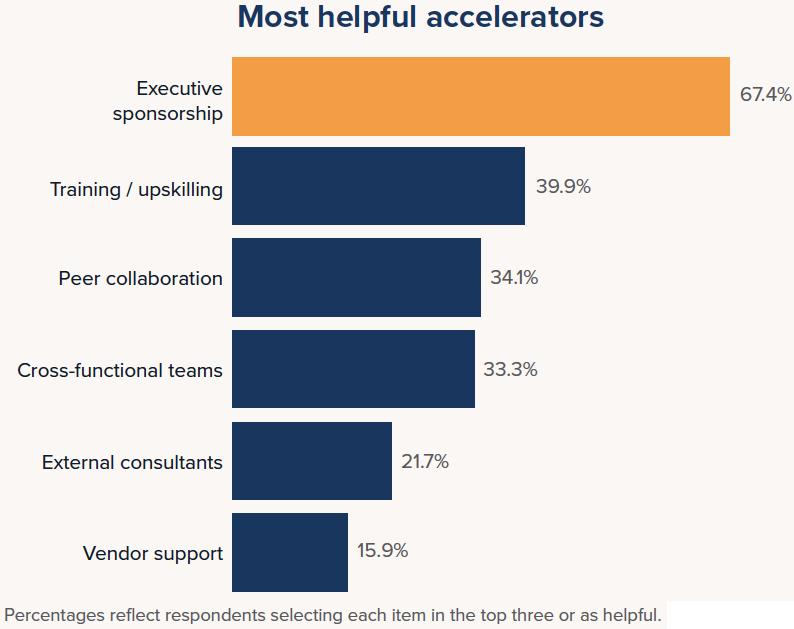
Executive sponsorship matters here. It was the strongest accelerator identified in the Index, cited by 67.4% of respondents. But sponsorship must mean more than approving a budget. Leaders have to establish boundaries, assign ownership, create permission to experiment and ensure that failed pilots produce learning rather than silence.
Somasundaram offers a practical starting point: pursue a small number of high-value, low-complexity projects rather than allowing hundreds of disconnected experiments to spread across the organization.
The next breakthrough for many distributors will not come from finding another AI model. It will come from paving a reusable road from problem selection to data access, integration, governance, measurement and scale.
Download NAW’s full 2026 AI Adoption Index to compare your organization’s progress with peers by function, revenue band and product sector.
Are you an NAW member? If so, you have access to our AI Adoption Index web dashboard. It serves as a straightforward webpage that allows you to quickly view the results of this AI Adoption Index sorted by revenue band and/or product vertical. It’s an easy way to toggle between those views so that you can view the results in a way that’s most applicable to your business.