




Uncategorized
2nd Estimate: U.S. 1Q GDP Revised Down to 1.6% Growth
The U.S. economy grew slower in early 2026 than first reported, as downward revisions to investment and consumer spending trimmed the Bureau’s initial estimate.

The U.S. economy grew at a slower pace to open 2026 than the Commerce Department initially estimated, according to revised data released May 28.
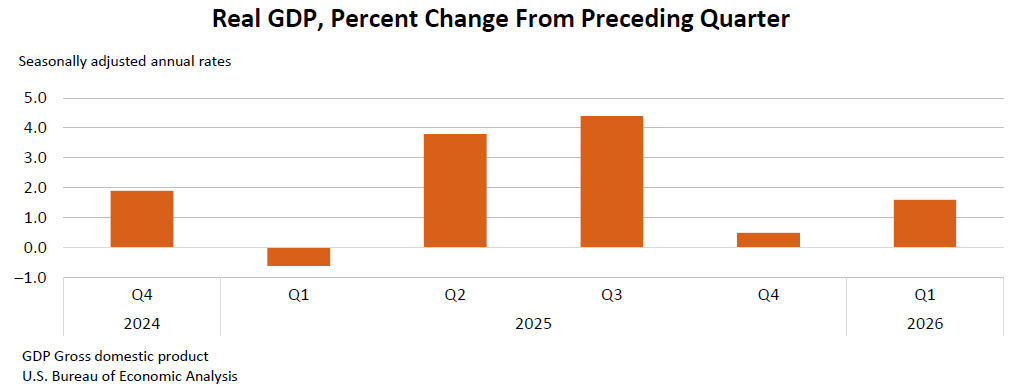
In the Bureau of Economic Analysis’ second estimate for U.S. GDP growth, figures showed that real gross domestic product increased at an annual rate of 1.6% in January-March. That’s down from the Bureau’s initial 2.0% estimate released April 30.
The revised figure still marks an acceleration from 4Q25, when real GDP increased 0.5%.
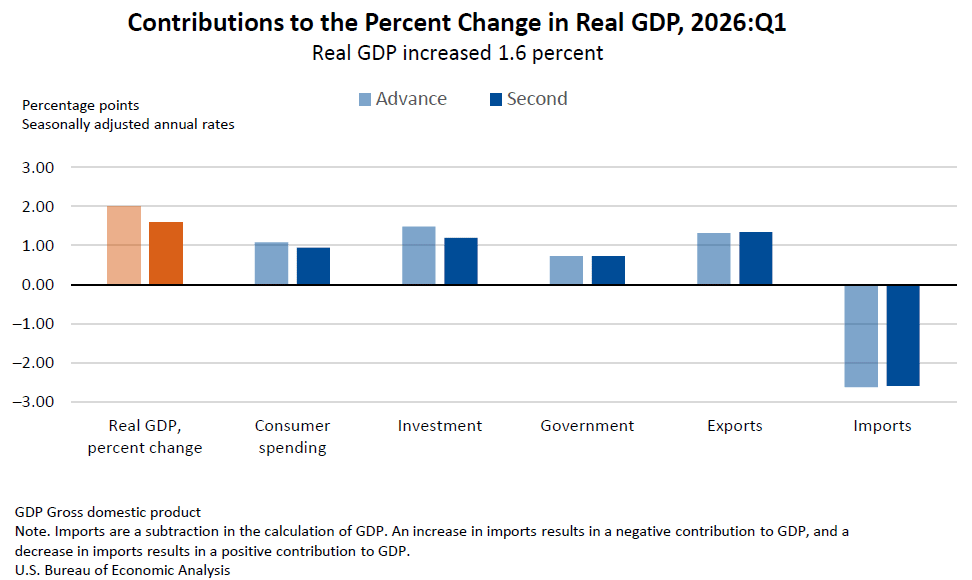
The Bureau said the contributors to 1Q growth were exports, investment, consumer spending and government spending. Imports — which are a subtraction in the calculation of GDP — increased.
BEA said the 0.4-percentage-point downward revision primarily reflected lower estimates for investment and consumer spending.
Within investment, the revision primarily reflected a downward revision to private nonfarm inventory investment, led by manufacturing and retail trade. The revision to consumer spending reflected a downward revision to services that was partly offset by an upward revision to goods.
Real final sales to private domestic purchasers — the sum of consumer spending and gross private fixed investment — increased 2.4% during 1Q, revised down 0.1 percentage point from the advance estimate.
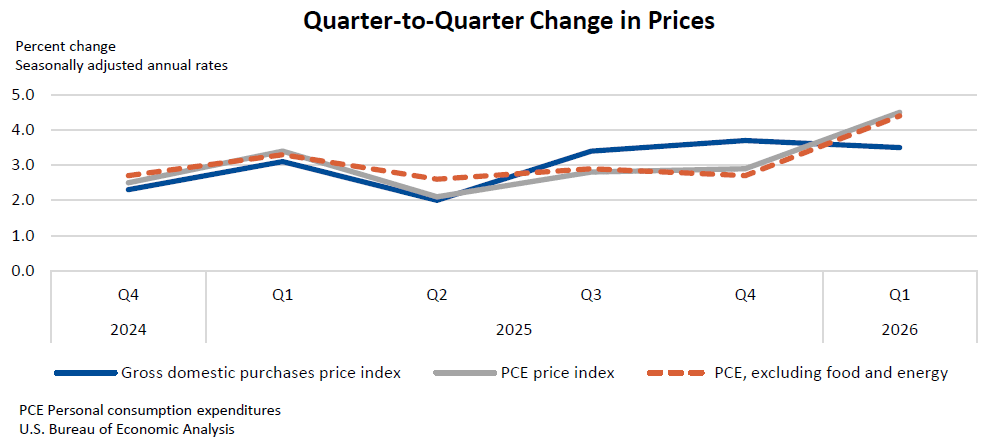
The price index for gross domestic purchases increased 3.5%, down from the initial 3.6% estimate. The PCE price index increased 4.5%, unchanged from the previous estimate, while the PCE price index excluding food and energy increased 4.4%, revised up from 4.3%.
MDM Analysis
As we noted when BEA issued its first estimate for 1Q GDP, the economy’s early-2026 acceleration was constructive but not especially strong. The second estimate reinforces that view. Growth improved from 4Q’s sluggish 0.5% pace, but the downward revision to 1.6% leaves 1Q expansion modest and below the longer-term trendline.
For distributors, the underlying mix remains more useful than the topline figure. Investment, exports, consumer spending and government outlays all contributed to growth, but the downward revisions to investment and consumer spending point to softer underlying momentum than initially reported. The inventory revision — led by manufacturing and retail trade — is especially relevant for distributors watching customer ordering patterns, replenishment activity and supply-chain normalization.
The cleaner demand read-through remained positive but slightly softer. Real final sales to private domestic purchasers increased 2.4%, revised down only modestly from 2.5%. That suggests domestic private-sector demand was still expanding entering 2026, though not at a pace that would eliminate the need for inventory caution, pricing discipline and close margin management.
Inflation also remains a key caution flag. PCE inflation held at 4.5%, while core PCE was revised up to 4.4%. For distributors, that keeps the operating environment mixed: demand remains supportive, but cost pressure, pricing execution and working-capital discipline should stay front and center.
Real GDP and Related Measures
|
||
| 1Q 1st Estimate | 1Q 2nd Estimate | |
| Real GDP | 2.0% | 1.6% |
| Current-dollar GDP | 5.6% | 5.1% |
| Real final sales to private domestic purchases | 2.5% | 2.4% |
| Gross domestic purchases price index | 3.6% | 3.5% |
| PCE price index | 4.5% | 4.5% |
| PCE price index excluding food & energy | 4.3% | 4.4% |