

Vendor Costs are Eating Your Margin. Your Bigger Competitors Don’t Have that Problem
New MDM data reveals that sub-$100M distributors face a fundamentally different margin threat than their larger peers — and the pressure is about to get worse.
Editor’s Note: Welcome to “The Hidden Majority” — a new column series from MDM authored by one of our top contributing writers, Nelson Valderrama. This series is all about providing thought leadership and industry analysis geared for small- to mid-sized distributors — which comprise the vast majority of the wholesale distribution landscape. Leveraging the quarterly Baird-MDM survey data, Nelson dives into the numbers and commentary to identify trends and takeaways that apply to SMBs in the industry.
Ask a $400 million revenue distributor, “What’s squeezing your margin?” They’ll tell you about competitive pricing. Nationals undercutting on bids. PE-backed consolidators buying market share. Amazon eating into their commodity business.
Ask a $30 million distributor the same question, and you’ll hear something different. They’ll tell you about vendor cost increases they can’t negotiate down. Operating expenses—labor, fuel, logistics—rising faster than revenue. Pass-through fatigue from customers who’ve absorbed one price increase too many.
These aren’t two versions of the same problem. They’re two different wars. And the data now confirms it.
Where This Data Comes From
The 1Q26 MDM/Baird Industrial Distribution Survey — conducted in early April — tracked 143 distributor responses from rotating questions on topics of margin pressure and pricing power. You won’t see the real story in standard, revenue-weighted reports, which are skewed toward the market giants. But when we isolate your sub-$100M segment and stack it against the over-$100M players, a stark, hidden pattern emerges: You aren’t just playing a different game. You are fighting a completely different war.
This is the second in our “The Hidden Majority” series examining what the survey data reveals about distributors under $100 million in annual revenue. The first article explored the gap between how sub-$100M distributors use AI and where the margin opportunity actually lives.
The Margin Pressure Split
The Q1 2026 survey asked distributors, “What is the biggest source of margin pressure for your business today?”
The answers diverge sharply by size.
For sub-$100M distributors, the real threat isn’t the competitor down the street; it’s the pressure coming from within their own supply chain. Their top margin drains are vendor cost increases (28%) and operating cost inflation (25%), while competitive pricing comes in third at 26%. Compounding this, another 13% of these smaller players report a total inability to pass through price increases to their customers.
Move up market to the over-$100M distributors, and the picture completely inverts:
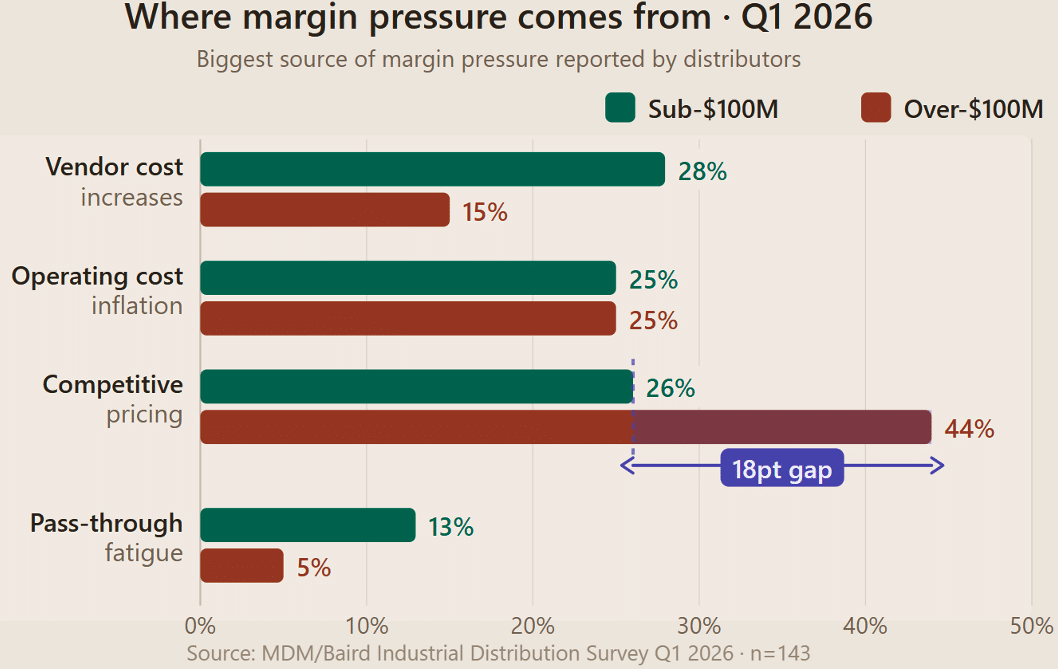 For the giants, competitive pricing is the absolute dominant pressure at 44%, while vendor costs drop to a minor 15%.
This massive 18-point spread on competitive pricing isn’t just a difference in degree. It’s a difference in kind. It proves that larger distributors are fighting an external market-share war, while smaller distributors are trapped in a defensive internal battle against escalating costs.
Two Different Wars
If you’re a distributor over $100M, you’re fighting a demand-side war. Your margin pressure comes from competitors matching or undercutting your prices. Because you have the scale to negotiate vendor costs down, that’s not where the bleeding happens. Your real challenge is holding your price in a market where other giants are willing to sacrifice their own margins just to take your market share.
But if you’re under $100M, you’re fighting a supply-side war. Your margin pressure is imposed on you—vendor increases you lack the leverage to push back on and operating expenses that scale poorly across your smaller branch networks. You aren’t losing on price because a competitor outbid you; you’re losing margin because your cost structure is devouring it before you even make the sale.
One distributor under $10 million put it plainly: “Delivery and logistics costs are certainly going to be problematic costs we have to absorb over the next several months. It is hard to pass on product cost inflation and delivery costs at the same time.”
A $25-$50 million distributor described the same pressure from a different angle: “Manufacturers are driven to raise prices and forcing distributors to tighten their margins.”
That’s not a competitive pricing problem. That’s a cost compression problem where the squeeze comes from above—from your vendors—not from beside you in the market.
The Vendor Cost Trap
The vendor cost pressure you face isn’t just about tariffs, though they compound it. Domestic manufacturers have used tariff-driven import cost increases as cover to raise their own prices, even when your products aren’t directly affected.
- “Our domestic manufacturers have taken this opportunity to increase costs minimally as a strategy to gain back lost margin due to low cost imported product.” — Distributor, $10-$25M annual revenue
- “Vendors are pushing forward with increases to cover the tariffs. Many have increased a full 25%, not the percentage of their components or raw materials, but on inbound shipping and handling as well.” — Distributor, $10-$25M annual revenue
If you are a $40 million distributor, you don’t have the purchase volume to push back on a vendor’s 25% increase the way a $400 million competitor does. Your negotiating leverage gap is structural, not situational. It was there before tariffs; tariffs just made it visible.
And your operating costs are just as relentless. Fuel surcharges, LTL rate increases, and labor costs hit you especially hard if you run multiple locations:
- “Increased transportation costs are a real-time impact and have already impacted gross margins with an increase to LTL fuel surcharges.” — Distributor, <$10M annual revenue
- “Current dynamics with fuel create a compressed operating margin environment.” — Distributor, $51-$100M annual revenue
When your vendor costs and operating costs rise simultaneously, your margin gets compressed from both sides. And unlike competitive pricing pressure, which at least signals market engagement, cost pressure is indiscriminate. It hits you whether you’re winning or losing in the market.
Pass-Through Fatigue Is Real
For you as a sub-$100M distributor, 13% reporting an inability to pass through price increases might seem like a small number, but it drastically understates your problem.
The 28% citing vendor costs and 25% citing operating costs are also facing these pass-through limitations. They just pinpointed the cost source rather than the failure to transmit it. One $10-25M distributor captured the dynamic in six words: “Price pass-through fatigue at customer level.”
This isn’t just about your decision to absorb costs. Your customers have simply reached their threshold. After tariff surcharges in 2024, price increases in early 2025, and current fuel-driven operating cost pass-throughs in 2026, your customers’ tolerance has a ceiling, and you are hitting it.
The 2025 survey data predicted this: In Q1 2025, 31% of sub-$100M distributors reported absorbing cost increases (compared to 18% of over-$100M players). A year later, distributors like you are now reporting that your customers simply won’t accept more.
Another <10M distributor described the challenge of trying to pass through multiple cost increases simultaneously: “The increased surcharges on freight and the increases related to re-buys on tariff items are impacting our ability to pass along related cost increases to the customers. They are aware of the reasons, but are still searching for product/sourcing that can even temporarily ease the increases.”
The customers aren’t irrational. They’re doing exactly what you would expect: shopping for alternatives. This shopping behavior generates the competitive pressure that over-$100M distributors cite as their primary margin threat. The two wars are connected: Your inability to absorb costs is what pushes your customers toward larger competitors who can.
Your Next Hit Is Already Scheduled
There’s a timing problem that hasn’t shown up in most distributors’ planning yet.
- “Distributors will begin lapping initial tariff price increases taken in 2025 soon. This will impact margin, especially those that took FIFO timing benefits last year.” — Distributor, under $10M annual revenue
You are facing a significant tariff-lapping risk. If you bought inventory at pre-tariff prices in early 2025 and sold it at post-tariff prices, you captured a temporary margin benefit. But that inventory has cycled through. Your replacement inventory now carries the full tariff cost. Your margin benefit is disappearing, even as your customers expect those current prices to remain.
For sub-$100M distributors already facing vendor cost pressure and pass-through fatigue, tariff lapping creates a third front. Costs are rising, customers are resisting, and the inventory buffer is gone.
Meanwhile, Your Competition Is Moving In
The cost pressure you face would be manageable if your competitive landscape were stable. It isn’t.
- “National distributors are moving down-market for smaller opportunities, squeezing our distributors. Margin erosion comes first, then share loss has been the outcome.” — Distributor, $10-$25M annual revenue
- “Nationals and Private Equity-backed competitors are coming after us aggressively. Using ultra-aggressive pricing, prebates, and free vending machines to entice our customers.” — Distributor, $26-$50M annual revenue
If you’re a sub-$100M distributor operating in a single region, you’re likely among the 71% reporting that competitive pressure has increased over the past three months. Compare that to your peers operating across multiple regions, where only 36% report the same. Same size, same revenue band, same survey quarter—the only difference is your geographic footprint. As a local-only distributor, you are getting squeezed in your home market by nationals and consolidators who are expanding into your territory.
- “More consolidation happening, which gives those small competitors of ours better pricing power and access to more and better lines. It is tough to be the last smaller independent distributor in our area.” — Distributor, $10-$25M annual revenue
This is your competitive squeeze at its most direct: your costs are rising from vendors and operations, your customers are resisting pass-throughs, and larger competitors are entering your market with pricing you can’t match. This isn’t because they’re more efficient than you — it’s because they have a fundamentally different cost structure.
The Current Data Raises New Questions
Here’s what the margin pressure data doesn’t tell you: what’s happening to your pricing power while all of this unfolds.
You are absorbing costs, hitting pass-through ceilings, and watching competitors enter your markets. Each of those pressures, individually, erodes your pricing power. Together, they compound.
The Q1 2026 survey asked a question that gets at this directly — how your pricing power compares to a year ago. The answers reveal something that you likely haven’t recognized yet.
That’s the subject of the next article in this series.